
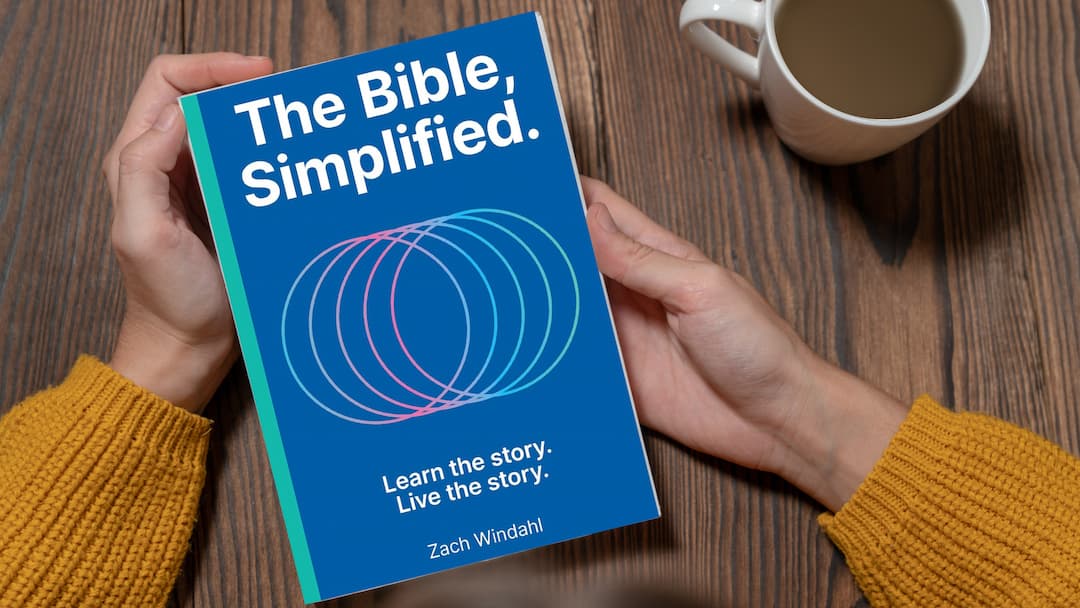
It has taken me a long time to write a review of The Bible, Simplified by Zach Wndahl because I struggle to critique any author, especially a brother in Christ, knowing what it must have taken to write a book and put it out into the world. But I also know I need to be honest in my assessment, especially when a book is aimed at new believers.
Here is my conclusion up front:
I cannot recommend this book to the audience for whom it is intended, the “beginner.”
If you want to know why, keep reading.
What I appreciated
There are many things I liked about this book, and there were times I wondered if what I appreciated could outweigh the places where I disagreed.
Windahl encourages us that,
“The Bible should be our lifeline. We need to study it as if we need it to breathe” (xii). I could not agree more.
This book offers a helpful 30,000-foot view of Scripture. It presents the overall story of the Bible and shows the cohesion between different authors, genres, and time periods.
I especially enjoyed the section that covered the 400 years between the Old and New Testaments. I do not have a lot of experience with the writings from that time, so I cannot say whether every detail was accurate, but it seems like a good starting point for someone wanting to explore that period.
I also appreciated Windahl’s treatment of the book of Revelation. He does not immediately jump to a dispensational, pre-tribulation rapture view. I was pleasantly surprised by how he handled the book, though there were still statements I questioned.
In truth, Windahl presents some ideas that made me stop and ponder, and in some cases, I understood things in a fresh way. That is always a win in my book.
However, there were also many ideas that set off alarm bells in my head.
Where I began to have concerns
In the introduction, Windahl says he will do his best to stay middle-of-the-road when it comes to doctrinal issues. In reality, that is impossible, and the book proves it. For example, he clearly comes down on the side of free will. That is not surprising, but it does mean his interpretation shows up throughout the book, even when he may not intend it.
There were many places where his wording made me uncomfortable because it painted a picture that did not quite line up with how I read the Bible. Here are only a few examples early on in the book:
- “Returning to the people we were originally created to be.”
This idea appears several times. While there is nothing wrong with that statement in itself, and it will be true in the New Earth, the context often suggests this kind of complete “return” on this side of heaven in a way that feels overstated. - Cain’s offering.
Windahl claims that God accepted both Abel’s best offering and Cain’s ordinary offering, but simply liked Abel’s better, which made Cain angry (34). This ignores the reality that God had a standard, and Cain fell short of that standard. To present it as God preferring one acceptable offering over another softens the seriousness of Cain’s disobedience. - The rainbow after the flood.
Windahl writes, “God even placed a rainbow in the sky, which Noah and his descendants saw as a symbol of this covenant” (49). This is misleading. Noah and his descendants saw the rainbow as a symbol of God’s covenant because God told them it was a symbol of the covenant, not because they simply chose to interpret it that way. - The Tower of Babel.
He writes, “Instead of making bricks in abundance to help struggling people, the Babylonians chose to build a great city, along with a massive tower…” (44). This is one of several places where I saw an undertone of social justice language. There are many ways the Babylonians could have used their bricks. To frame the entire episode primarily as an oppressor vs. oppressed issue does not seem faithful to the emphasis of the biblical text, which focuses on pride and the desire to “make a name” for themselves. - Israel “needing” a king.
In 1 Samuel, the chapter begins with, “Israel was in great need of a king, someone who could lead the people in the ways of God” (103). Was Israel really in great need of a king? Or were they coveting what their neighbors had? On the next page, Windahl includes the passage where Samuel explains the heavy demands a king will make on the people, which actually underscores that God gave them what they wanted, not what they needed.
There are multiple places where the account presented is different from how the Bible presents it. At times, the wording gives the impression that Israel thwarted God’s plans, and in other places, liberties are taken where Scripture is not explicit.
My main concern: how the gospel is defined
My biggest issue with this book is how Windahl defines the gospel.
He writes: “Jesus entered each new city claiming that he was now King. A new kingdom had arrived. And what was the good news of Jesus’ kingdom? The blind could see, the lame would walk, people with leprosy were cleaned, the deaf could hear, the dead were raised, the poor were taken care of, and the sins of humanity were forgiven” (166).
Of course, Jesus did perform miracles. He did care for the poor. But the good news of the gospel is not that the blind will see, the lame will walk, that our loved ones will be raised from the dead this side of heaven, or that we will never be poor.
The gospel begins and ends with the solution for sin.
The heart of the good news is that, through the life, death, and resurrection of Jesus, sinners can be forgiven and reconciled to God.
To define the gospel primarily in terms of physical healing and temporal care blurs that central truth, especially for newer believers who are still learning what the Bible actually promises in this life.
So who, if anyone, is The Bible, Simplified for?
You might feel like I am being nitpicky with this book, and in some ways, I am.
If you are already in the Word on a regular basis, have read it from cover to cover, and are comfortable handling Scripture, I have no problem recommending this book to you. You are more likely to notice where you agree, where you disagree, and where you need to study further.
The truth, though, is that if this describes you, the book is largely superfluous. It is not bad, but it is also not necessary.
This book is marketed to young Christians. It is for the believer who needs a guide to the Bible, the believer who does not yet understand how all the pieces fit together.
If that is you, I worry that this particular book could lead you astray in subtle but important ways.
My encouragement would be to dig into the Bible itself. And if you need a resource to help you do that, reach out to me and let me know. There are many other options I would be more comfortable recommending.
I give The Bible, Simplified 3 out of 5 stars. It is not a bad book. There were things I genuinely enjoyed and learned from it. But it requires a level of discernment that usually comes from spending time in the Bible itself, not primarily in books about the Bible.



0 Comments