Does life ever feel like you’re spinning your wheels, trying to trap waves on the sand, or juggling too many plates? As we chase the things this world has to offer, it often feels like we are “striving after wind.” Nothing is ever enough. Happiness is fleeting. We never arrive.
Even as a child, I remember a feeling of dread for the holidays or a vacation, because as soon as it was over, the excitement of the moment disappeared. I dreaded the low after the high. Solomon understood this better than most, and he explains it to us in the book of Ecclesiastes.
The book of Ecclesiastes is a strange book in the Bible. It spends all twelve chapters telling the reader how pointless life is. But there are a few things to consider as you read the book that will change your perspective a bit and may even lead you to love the book.
Consider the Literary Context
First off, the book of Ecclesiastes was most likely written by Solomon. He is never mentioned by name, but the first line of the book attributes it to, “the Preacher, the son of David, king in Jerusalem” (ESV).
Throughout the book, the Preacher references his own wisdom. If we remember the account of Solomon, one of the most notable events of his life was when God offered Solomon anything he wanted, and Solomon asked for wisdom. God granted Solomon’s request, and he became the wisest man who ever lived. Because Solomon was the wisest man who ever lived, and he knew the Lord, though his behavior didn’t always seem to demonstrate this fact, we should listen to what he has to say in the book of Ecclesiastes.
The book of Ecclesiastes is wisdom literature. It is in the same category as Proverbs, Job, and the Psalms. Wisdom literature is based on principles, not promises. It often contains apparent contradictions, and it encourages personal contemplation.
Often wisdom literature teaches us how the world should work: If you do this, then that will happen. But the book of Ecclesiastes takes it a step further as it is pessimism literature, demonstrating that because the world is sinful, there are exceptions to the rules. It essentially asks, “If there is no eternity, then why does it matter what I do and how I live?”
Follow the Quest
In Ecclesiastes, the author is on a quest to discover the meaning of life. Just as the book says, there is nothing new under the sun, and the quest for purpose has been a driving force in every generation. As you read the book of Ecclesiastes, track the Preacher’s progress.
He begins by searching wisdom, then pleasure, then work, etc., and his conclusions for life under the sun are depressing. But he ends his quest finding purpose. After he searches through all of the things of this world, he comes to a satisfactory, even desired, conclusion.
Notice the Dichotomy in Ecclesiastes
As you read Ecclesiastes, take note of some very important phrases. First, you will find many instances of the phrase “under the sun.” This phrase represents life on this earth, living by the world’s “rules.” It is life “under the sun” that is “a striving after wind.” And each time we encounter that little phrase “under the sun,” we are invited to consider if there is an alternative.
What we discover is the phrase “under the sun” is set up in contrast to the phrase “under heaven,” which could also be read as “beyond the sun.” The phrase “under heaven” represents life with an eternal perspective. Chapter 3 of the book is a good example of this as it lays out God’s harmony in creation, presenting a time for every event “under heaven.”
Notice the inconsistencies in an “under the sun” perspective: Work is good and also bad, death is welcomed and also feared, food and wine are enjoyable and also meaningless. Any worldview that is not based on God’s principles and guidelines will be inconsistent, not able to sustain itself when followed to its logical conclusion.
An “under heaven” perspective, however, is very consistent. It follows logic and order. It leads to a reason and purpose not only for joy and work and beauty, but also for suffering and pain in this life. Only the biblical worldview makes sense.
Recognize God’s Sovereignty
A main point of the book of Ecclesiastes is God’s sovereignty. The book repeatedly reminds us that even though this world seems to be topsy turvy, God is still in control. If we choose to live life as if God doesn’t matter, we are “striving after wind.” But if we choose to live life recognizing Who God is and His sovereign plan, we can enjoy the gifts He gives us and look forward to the better gifts in eternity.
Find Freedom
As believers, we experience the privilege of enjoying life. Because God is in control even when things seem to be out of control, we as believers have the freedom to take pleasure in the beauty of God’s creation, in the benefits of our work, and in the fruit of our communities without fearing that our failures will derail His plans. We can trust that God has it all in hand, and we know that we are laying up treasures in heaven that will last far longer than any suffering this world can dish out.
Take Action
Ultimately, the book of Ecclesiastes is an Old Testament Apologetic. While the author takes us on a journey of meaninglessness, he is showing us what life is like if it is true that God does not matter. Anyone who lives his life only for this life, crying out “YOLO” (you only live once) every chance he gets, is living a purposeless, meaningless life that never brings true happiness or fulfillment. Everything in this life is temporary.
By showing us the purposelessness of this life, the author is demonstrating the alternative to living a life that is pleasing to God, seeking to follow His ways, and focusing on an eternity in His presence. He is arguing for a life lived in the fear of the Lord by showing us the unfavorable alternative.
In light of this, we must recognize that it is part of our biblical calling to examine all things in light of eternity. The most loving thing we can do is to call sinners to repentance, not only because it will affect their eternal destiny, which is enough reason in and of itself, but also because without repentance and an acknowledgment of Who God is and the role He plays, their lives here on this earth will be without purpose, fulfillment, and true happiness. They will be “striving after wind” and getting nowhere.
Updated: This post was originally published on October 30, 2021.
Do you dread reading prophecy in Scripture? Do you worry that it will be “over your head”? So many people have differing opinions about the interpretation of prophetic texts, so how can we know which one is right? Should we even bother to figure it out? Shouldn’t we just watch things play out rather than trying to guess what’s coming?
Prophecy in Scripture can certainly be challenging, and there are many things that will simply be revealed in time. But here are a few tips to help you navigate some of the hurdles you might encounter.
It Is Prophecy, i.e. the Future
One thing to keep in mind is that it is prophecy, which means, at the time the prophet spoke it and wrote it, it hadn’t happened yet. Much of prophecy was given to convince God’s people to repent. The prophecy wouldn’t come to pass if the Israelites would simply turn back to God. Unfortunately, they rarely listened.
It is also important to keep this in mind when we come across the passages where God will punish other nations even as He used them to discipline His people. We often see this as unfair, but those other nations knew about God. They understood that Israel was a nation set apart. They had every opportunity to turn from their wickedness and follow the God of Israel. The prophecy was yet another instance where God gave them that opportunity.
False Prophets Were Also Prophesying
Does prophecy intimidate you? Here are some tips to help you understand prophecy.
It is easy for us to sit back and judge the Israelites when the prophecy seems so clear. How could they not understand what was coming? Yet it is important to remember that, at the same time that God’s chosen prophets were calling the Israelites to repentance, there were false prophets contradicting them. The Jews often chose to follow the “prophets” who were saying what they wanted to hear rather than holding their words up to the character of God.
Scripture tells us that a true prophet proved his authority by speaking the truth about future events (Deut. 18:21-22). So we may think it was difficult to tell the difference between a true prophet and a false prophet. After all, until his prophecy came true, no one could know. However, God gave specific characteristics of a true prophet in Deuteronomy 13:1-11, and one of them was that a prophet never encouraged God’s people to worship another god. This wasn’t limited to golden idols but would also include the god of self, the god of nation, and the god of pleasure. A true prophet would continually point the people to God and God alone.
With Prophecy Comes Hope
Some of the prophecies in Scripture seem to be disastrous. However, even when it is not officially stated, every prophecy comes with hope. Whether hope lies in a future event here on earth or in the triumphant return of Christ, the hardships will pass and His people will be victorious. As you are reading prophecy, look for the hope that is coming.
Prophets Used the Language They Knew
There are many times when reading prophecy that we come across figurative language. Are the locusts in Joel really locusts or is it an army? Are we really looking for a lamb, or is that a metaphor for a person? And what about the book of Revelation? Is it really a beast, a number, and a war? Sometimes it is difficult for us to know, first, if the language is figurative or literal, and second, if it is figurative, what it means. The truth is you can read ALL the commentaries and walk away with no clearer picture than when you started.
Nonetheless, we must always remember that all Scripture is inspired and profitable. While the prophet may have been describing things for which he had no vocabulary or the message he received was full of imagery, his message is still important for us to know. We should still approach the passage prayerfully, read for the purpose of understanding, and do the work of study and discovery. We may not end up with a clear picture, but we will learn and grow through the process.
Don’t be intimidated by the prophetic passages and books of the Bible. Remember that the Word of God is living and active, and approach it with eagerness to discover Who God is.
One thing that really jumped out at me as I have been studying the book of Genesis is the difference between how Sarah treated Hagar’s son and how Rachel treated the sons of Bilhah. Culturally speaking, Ishmael was Sarah’s son and Dan and Naphtali were Rachel’s sons (though the Bible clearly specifies who the mothers truly are), yet while Rachel seems to have accepted the boys as her sons, Sarah completely rejected Ishmael.
We find Sarah’s story in Genesis 16 and 21:8-21. Abraham and Sarah had been married for a long time, and they were both getting old, but they had no children. God had promised Abraham that He would make Abraham a great nation, but with each month that passed, Sarah wasn’t pregnant. She eventually hatched the plan to give her servant Hagar to Abraham so Sarah could have a child through Hagar. Even though her plan worked, Sarah was more miserable than before. Genesis 16:4 tells us that, “when [Hagar] saw that she had conceived, she looked with contempt on her mistress [Sarah].” Sarah went so far as to treat pregnant Hagar so harshly that Hagar fled into the wilderness. The angel of the LORD found Hagar, told her she would have a son, and convinced her to go back to Sarah.
Rachel’s story is a little more complicated because she was Jacob’s second wife. We read all of the details in Genesis 29:9-30:24. Jacob was in love with Rachel, and he worked for her father, Laban, for seven years as a condition to marry her. But on their wedding night, Laban switched Rachel out for Leah, her older sister. A week later, Jacob married Rachel with the requirement that he work for Laban another seven years. Before we know it, Leah started having children, but Rachel was barren. After Leah had four sons, Rachel gave her servant Bilhah to Jacob in desperation, so she could have children through Bilhah. Bilhah had two sons, and this seemed to appease Rachel somewhat. There is no indication in the text that Rachel mistreated Bilhah or rejected her sons.
As I read and reread these passages, studying the book of Genesis, I realized that their situations, though similar, were also very different. From the beginning of her marriage, Rachel had watched her sister bear son after son. Jacob and Rachel had no children, but it clearly wasn’t a problem with Jacob. Rachel had to accept early on that she could not have children.
Sarah, on the other hand, was Abraham’s only wife. For their entire marriage, there was always the question: was Abraham sterile or was Sarah barren? Culturally, the blame always fell on the wife, but I imagine Abraham and Sarah had this conversation periodically throughout their marriage. All doubt was removed the second Hagar announced she was pregnant. The couple’s infertility issues lay squarely on Sarah. This could surely cause Sarah to lash out, as she did, not only at Hagar, but also at Abraham. It also explains her bitter laughter when the three visitors tell Abraham that Sarah will have a child after she has already gone through menopause (Genesis 18:9-15).
While this realization broke my heart for Sarah, it was also sobering to recognize this was pain of her own making. While the suffering she faced in infertility was something God would use for His glory, the suffering she experienced by watching Hagar bear Abraham a son was a natural consequence of her lack of faith. God had already promised to make Abraham and Sarah a great nation, but He wasn’t moving fast enough for Sarah. Perhaps she thought she needed to help the plan along. Perhaps she thought God gave her this scheme to use Hagar. Perhaps she thought the promise was only for Abraham, and not for her, too. As a result, she got ahead of God. It is clear that Abraham developed a relationship with Ishmael, Hagar’s son, which probably strained his marriage with Sarah. And we see that she allowed this pain to take root in her heart and turn in to bitterness. How much sweeter would it have been when she gave birth to Isaac if she had simply trusted that God would do what He promised in His time? How much heartache would she have spared herself, Abraham, Hagar, and the nation of Israel if she had believed God is faithful?
While Rachel’s story is not exactly a romantic fairy tale—after all, Leah and Rachel barter for sex with Jacob over some mandrake fruit (Genesis 30:14-16)—Rachel dealt with her insecurities very early on in her marriage, and she was always especially treasured by Jacob to the detriment of his children. I could write an entire post about Leah’s relationship with Jacob. Suffice it to say, though Jacob always chose Rachel, in the end God chose Leah by placing Judah, her son, in the lineage of Christ.
There are several lessons for us in the account of Sarah. Throughout the entire book of Genesis, God repeatedly says “I will.” The fulfillment of God’s promises is wholly and completely dependent on Him, not us. We don’t need to make our own plans, come up with schemes, or kick down doors. That never works in our favor and is often detrimental not only to us, but also to those around us.
You might be asking why the Bible is full of stories of barren women. After all, God promised to make Abraham a great nation, yet he was married to a woman who would give him one son in their old age. Not quite the same as the number of stars in the sky and grains of sand as he was told. When Sarah laughed at the prophecy of the visitors in Genesis 18, they asked a very important question in response: “Is anything too hard for the LORD?” God chose to use barren women, even one who had already gone through menopause and was ninety years old, to demonstrate that no, nothing is too hard for Him. There was no question in anyone’s mind about the birth of Isaac being a miracle. It was why Abraham could “rise early in the morning” eager to obey God when God commanded him to sacrifice Isaac, the promised child of the father of the Israelites.
While the story of Sarah tugs at our heartstrings, especially as women, God teaches these lessons again and again throughout the book of Genesis and beyond. We see it in Isaac’s life, Jacob’s story, and Joseph’s drama (and oh, what a drama it is!). God’s plans will not be thwarted by our interference. He will fulfill His promises because of Who He is. Nothing is too hard for the Lord!
Are you trusting Him in your life, or are you trying to take the lead, hoping He backs you up?
When discussing the role of women in the church, there are some terms that need defining. Not only do these terms need to be defined, but we need to recognize that they are on a sliding scale. This means that not all of those who would classify themselves with the same title believe the same thing. The two main terms associated with this topic are egalitarian and complementarian. So let’s begin there.
The term egalitarian means “asserting, resulting from, or characterized by belief in the equality of all people, especially in political, economic, or social life” (dictionary.com). When we look at this word in the context of this discussion, an egalitarian believes there are no differences in role or authority between men and women in the church. Therefore, a woman is just as capable and has just as much right as a man to be a pastor, deacon, elder, or janitor. It is important to note that an egalitarian believes that men and women are different in biology, but they are equal in role and authority in the church and possibly in the home.
The other main term associated with this discussion is complementarian. This term revolves around the idea that men and women were created to complement one another. They are equal in importance, dignity, and worth (value), but they have distinct roles and levels of authority in different situations, roles that work in tandem with one another. So for the purposes of this discussion of the role of women in the church, a complementarian believes there are specific roles in the church that only a man can fill according to the Scriptures. While there are roles that are traditionally filled by women, a complementarian would not argue that, biblically, men are banned from any position in the church (though they may argue for the prudence of it).
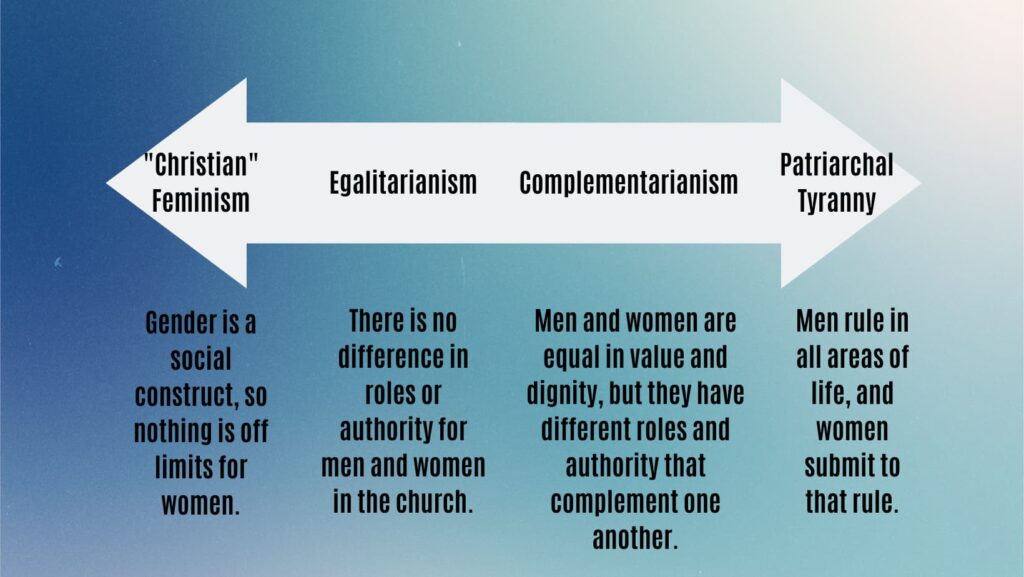
The positions regarding the role of women in the church are on a sliding scale.
However, we must recognize that this is a sliding scale. Some complementarians, on the “softer” side, would limit the number of positions forbidden to women, while “stronger” complementarians may ban women from any position with any level of authority even over children. If you slide too far to the stronger edge of complementarianism, you’ll land in the territory of patriarchal tyranny where men rule and women obey. While I don’t believe the patriarchy itself is a negative thing as our society tries to convey, patriarchal tyranny creates a controlling and abusive atmosphere. There is pretty solid biblical evidence against this position of abusive patriarchalism, so complementarians must be careful not to cross that line.
Likewise, if an egalitarian slides too close to the permissive edge, he will land squarely in “Christian” feminism (an oxymoron in my opinion) where gender is seen as a social construct and nothing is off limits to women or men, including blurring the gender lines. This is an idea clearly contrary to Scripture (see Genesis 1:27). So the egalitarian must watch that he does not cross into that sinful territory.
While a discussion of the biblical merits of both “Christian” feminism and patriarchal tyranny is probably superfluous, the debate between egalitarian and complementarian ideas rages on. As we approach this discussion in upcoming posts, there are a few things to keep in mind:
1. This discussion in Scripture is limited to the church. Nowhere does Scripture elicit a debate about the role of women in politics, business, education, etc. If you are delving into that territory, you are wading into tyrannical waters. In fact, I believe I can make a pretty clear case for women in those arenas with Scriptural support. One only needs to look at the Proverbs 31 woman to begin the discussion.
2. The conflict is only about the authority a woman has over men, not children or other women, in the church. Scripture encourages women to teach other women and to teach children, though it is important to decide when a boy becomes a man if you fall into the complementarian camp.
3. Scripture addresses the topic of the submission of women in only two arenas: the home and the church. It does not teach that all women are to submit to all men. It does not teach that all women are subject to all men in the church. And it is important to point out that Scripture clearly teaches that we are all to submit to one another, the husband and wife and the priesthood of believers. We must tread lightly so we do not take this further than Scripture does.
Note: We will not be broaching the subject of the wife’s submission to her husband because each home can look different while adhering to God’s standards, so we will limit our discussion to the church arena where Scripture gives guidelines for all believers to follow.
The book of Genesis is under attack! In fact, it has probably been under attack in one way or another since it was written. Not only is Genesis the seed plot of the Bible where every other account of Scripture begins, but also it tells the story of Satan’s deception and ultimate failure. Because it is foundational to everything else in the Bible, Satan knows if he can get us to doubt Genesis, we will throw the Bible out all together, and nothing would make him happier.
The biblical account of creation is under attack
In the beginning, God created the heavens and the earth.
Genesis 1:1 (ESV)
Currently, the attack on creation is through the faulty theory of darwinian evolution. While much of the scientific community has rejected evolution as a plausible explanation for how we came to be, it has been taught for so long that it is ingrained in our culture, accepted by most of our society. It has infiltrated cartoons, movies, even some “Christian” literature. We could spend time discussing all of the ways the theory of evolution falls short of a scientific fact, the differences between micro and macro evolution, or the unreliability of carbon dating, but the truth is if it wasn’t evolution, it would be a different theory.
The theory of evolution and the Big Bang Theory are not believable in the least, yet mankind would choose to believe we came from stardust or primordial sludge rather than believe the biblical account of creation because to accept God as creator means to accept Him as judge. If He created the universe, then He gets to say what happens, what is good and what is bad, and what brings Him glory. Satan himself rebelled against God’s authority, so he rejoices in our deception in this area.
Biological sex is under attack
So God created man in his own image, in the image of God he created him; male and female he created them.
Genesis 1:27 (ESV)
While it may seem that the transgender movement is fairly new, it has been around for a long time. It is actually simply the logical conclusion of the feminist movement. God’s ultimate creation was mankind, created in the image of God, and created as two distinct creatures made to complement one another.
When we question our identity based on how we feel, we are questioning God’s goodness in creating us for the purpose of glorifying Him. When we dig into the Bible and discover our identity through Him, we allow our knowledge to override our feelings. Satan would love for us to get lost in emotionalism, questioning who we are and why we’re here, and finding our answers in our feelings rather than God’s Word.
The family is under attack.
Therefore a man shall leave his father and his mother and hold fast to his wife, and they shall become one flesh.
Genesis 2:24 (ESV)
Because the family is the foundation of society, dismantling it is a great tactic to destroy God’s intended plan. We were created for community, and the first community we have is our family. Parents are tasked with raising their children in the knowledge of God. Deuteronomy 6:7 tells us exactly how to do that, “You shall teach them [the words He commanded them] diligently to your children, and shall talk of them when you sit in your house, and when you walk by the way, and when you lie down, and when you rise.” The goal of parenting is to create in our children a biblical worldview.
What God created as a perfect union—because it is a picture of His relationship with His people—was marred by sin. Children are not supposed to be fatherless, abused, neglected, or murdered in the womb. Wives are not supposed to be ignored, abused, or controlling. Husbands are not supposed to be emasculated, ridiculed, abusive, or weak. Because society has followed the ways of the world rather than the ways of God, we have drifted away from God’s purpose for the family.
This is the book of the generations of Adam. When God created man, he made him in the likeness of God.
Genesis 5:1 (ESV)
The book of Genesis teaches us that there is only one race. We are all descended from Adam and then from Noah. God did not create different races to be different in value. He created one race: the human race. In fact, when we read the account of the Tower of Babel in Genesis 11:1-9, we find that ethnic lines were created by language differences, not skin color.
But if Satan can get us to hate one another or try to control one another based on the color of our skin, then he gets us to dishonor God’s creation of humanity. Every human being, no matter his culture, color, language, or country is an image bearer of God because he is descended from Adam, the original image bearer.
The earth is under attack
While the earth remains, seedtime and harvest, cold and heat, summer and winter, day and night, shall not cease.
Genesis 8:22 (ESV)
Not only does the climate “crisis” take our attention off of the things we should be focused on, it also gives us a false sense of control over God’s creation. It is a way for us to think we know better than God and act accordingly. When we interfere with God’s creation and how it works, at best, it is a futile waste of energy, and at worst, we actually cause more harm.
What God created, He sustains. I’m not advocating for setting out to destroy the earth, but the earth was created for us to subdue, not the other way around. God’s creation is a testament to God’s creativity, pleasure in beauty, and even sense of humor. If the polar ice caps melt, that is God’s plan. If a species goes extinct, that is also God’s plan.
But Satan longs to distract us with causes that waste our time and energy. We can trust God to sustain His creation because He promised He would. While we honor His creation, we cannot do His job.
God’s promises are under attack
And God said, “This is the sign of the covenant that I make between me and you and every living creature that is with you, for all future generations: I have set my bow in the clouds, and it shall be a sign of the covenant between me and the earth.”
Genesis 9:12-13 (ESV)
God created the rainbow as a sign of His promise to us that He would never again destroy the whole earth with water. By taking the symbol of God’s promise and perverting it to be a symbol of a lifestyle that is a direct affront to God’s commands, we attack His promises. Furthermore, the climate “crisis” is a manifestation of our unbelief in this specific promise.
It seems that everywhere we turn, the book of Genesis is under attack. In every case listed, Satan has taken something God created and called “good” and twisted it into a counterfeit of truth. Much like he did with Eve in the Garden of Eden, he asks us on a daily basis, “Did God actually say…?”
Genesis fights back!
But take heart, my friend, because Genesis fights back!
I will put enmity between you and the woman, and between your offspring and her offspring; he shall bruise your head, and you shall bruise his heel.
Genesis 3:15 (ESV)
This is the first promise of a coming Messiah. While Satan set out to destroy God’s creation, God had already set in place a plan of redemption and the ultimate defeat of the enemy. No matter how much Satan questions God, hates His Word, or deceives us, God is still in control!
Let me leave you with some words of comfort from Psalm 2:
Why do the nations rage and the peoples plot in vain? The kings of the earth set themselves, and the rulers take counsel together, against the LORD and against his Anointed, saying, “Let us burst their bonds apart and cast away their cords from us.”
He who sits in the heavens laughs; the Lord holds them in derision. Then he will speak to them in his wrath, and terrify them in his fury, saying, “As for me, I have set my King on Zion, my holy hill.”
Psalm 2:1-6 (ESV)
This post only goes through Genesis 11, and there are 50 chapters in the book. In what other ways is the book of Genesis under attack? I would love to hear your thoughts.