A couple of years ago, I recognized that if I lost access to the Bible, I didn’t have enough of it stored up in my memory to hold on to it in tough times. So I started the spiritual discipline of memorizing Scripture. Mind you, at that point I was 40+ years old. I had a real fear that my brain couldn’t do it. I was already struggling to remember people’s names and connecting them to a time and place in my life. I had also watched my dad succumb to early-onset Alzheimer’s. Could I really memorize Scripture and retain it? It helped to have some tips and tricks, so I want to share those with you.
Why Memorize Scripture
But let’s take a step back and talk about why it is important to memorize Scripture. Beyond the threat of losing access to Scripture on our shelves and on our phones, the Bible tells us to hide God’s Word in our hearts. We are given this command for several reasons.
As a mom, one of the most important reasons for me to memorize Scripture is detailed in Deuteronomy 6:6-7, which tells us to hide His words in our hearts and “teach them diligently to [our] children.” I can’t teach my kids something I haven’t learned.
Of course, the spiritual discipline of memorizing Scripture isn’t limited to parents. Every believer is instructed to meditate on God’s Word day and night. Often, when we read Scripture, we walk away from it and don’t think about it again, but when we memorize Scripture, we are rehearsing it, repeating it, meditating on it throughout the day. And as we practice and repeat a passage, it takes root in our hearts and our understanding of the passage grows.
Ultimately, the goal is to be shaped by Scripture—to develop a biblical worldview, the lens through which we see the world. Memorizing Scripture allows the Word of God to inform our thoughts, which shape our feelings and actions. Living life with a biblical worldview is for our good and is how God intended us to live.
Don’t Believe the Lies
While there are many excuses NOT to memorize Scripture, what you have to decide is how important it is to you. Are you willing to do the work, to practice, to train, and to strive for godliness? We know we can memorize information that is important to us—if I asked you to tell me your social security number, I have no doubt it would be top of mind, or if your favorite song comes on the radio, it isn’t hard to sing along. Don’t believe the lie from the enemy that you are not capable of committing Scripture to memory.
So let’s get into the tips:
How to Memorize Scripture
First, decide which translation you want to use (to see a discussion on the spectrum of translations, see this blog post). Are you more familiar with one translation? Is there one that is easier for you to understand? I’m personally partial to the translations closer to the word-for-word end of the spectrum. I would encourage you NOT to choose a paraphrase simply because paraphrases are someone’s interpretation of someone else’s interpretation so they are further away from the original than a translation will be.
There are many ways to memorize, and they will appeal to you depending on your learning style. If you are a visual learner, you might want it typed up and laminated so you can take it with you. If you are an auditory learner, you may want to record it in a voice memo to play back or put it to music. If you are a kinesthetic learner, you might enjoy putting motions to the passage. Whichever type of learner you are, memorization requires repetition.
The system I use to commit Scripture to memory is below. Feel free to modify it as best suits your learning style.
For the first verse in the passage:
Step 1: Read the verse aloud 10 times.
Step 2: Recite the verse 10 times.
Step 3: Write the verse from memory.
When you get to the second and future verses in the passage:
Step 1: Recite the previous verse 10 times.
Step 2: Read the new verse aloud 10 times.
Step 3: Recite the new verse 10 times.
Step 4: Write the new verse from memory.
Step 5: Recite the passage from the beginning.
I like to use the FLOW method to remember the verse throughout the day. FLOW stands for First Letter Of the Word. You can write the first letter of each word in the verse on your hand, set them as the wallpaper on your phone, write them in your planner, put them on a post-it note and put it where you will see it frequently, etc. This reminds me to rehearse the verse as I go about that day’s activities.
I’m always open to new ideas, so if you have another method that has worked well for you, please share it!
If you would like to learn more about how to study the Bible, I invite you to download my FREE Bible study workbook, 6 Steps to Study the Bible on Your Own, at the button below.
If you would like to join a group of like-minded women who are pursuing godliness together, check out the Bible Study Academy by clicking the button below.
I was not catechized as a kid. I don’t know if it is because catechism was a foreign concept to my parents, or if it was because I grew up in a Roman Catholic country, where catholicism is engrained in the culture, and there is a lot of repetition with very little belief. For whatever reason, this is something I wasn’t exposed to as a kid. Now that my own kids are teenagers, I have only recently discovered catechisms.
According to Meriam-Webster, a catechism is “a summary of religious doctrine often in the form of questions and answers.” Different religions have their own catechisms. Two catechisms I’ve encountered are the Heidelberg catechism and the Westminster catechism. They are a series of questions about the different aspects of theology, along with the answers supported by Scripture.
The idea is the teacher asks a question, and the students respond in unison with a memorized answer. For example, question 1 of the Westminster Shorter Catechism is “What is the chief end of man?” And the answer is “Man’s chief end is to glorify God, and to enjoy him forever.” The Scriptures that supports this answer include 1 Corinthians 10:31 and Psalm 73:25-26.
For those who grew up in a strict or legalistic environment that required catechism, it can be difficult to separate catechism from negative memories, but most adults I’ve asked who were catechized as children are grateful. They have had the memorized answers bouncing around in their memories as the world seems to have spun out of control.
But let me encourage you. God’s timing is perfect. So you are not too old to be catechized. And, truth be told, you may understand and appreciate it more as an adult. It is never too late to learn the catechism questions and answers and to dive into the Scripture that teaches the principles.
Are you ready to learn about things like justification, the commandments, and prayer? If so, join me in learning the Westminster Shorter Catechism. I have linked a couple of resources, and I will be creating posts of the different questions each week on my Instagram account.
There is a huge difference between breaking a rule because you don’t like the rule and breaking a rule because the rule is wrong, based on lies or fear, or harmful physically, mentally, or emotionally. And teaching your kids to discern the difference is the epitome of good parenting.
Teaching your kids to stand for truth is not encouraging a rebellious spirit. It means you’ve taught them what truth is, and you’ve taught them HOW to think instead of WHAT to think.
“Then the king of Egypt said to the Hebrew midwives, one of whom was named Shiphrah and the other Puah, ‘When you serve as midwife to the Hebrew women and see them on the birthstool, if it is a son, you shall kill him, but if it is a daughter, she shall live.’ But the midwives feared God and did not do as the king of Egypt commanded them, but let the male children live. So the king of Egypt called the midwives and said to them, ‘Why have you done this, and let the male children live?’ The midwives said to Pharaoh, ‘Because the Hebrew women are not like the Egyptian women, for they are vigorous and give birth before the midwife comes to them.’ So God dealt well with the midwives. And the people multiplied and grew very strong. And because the midwives feared God, he gave them families.” Exodus 1:15-21 (ESV)
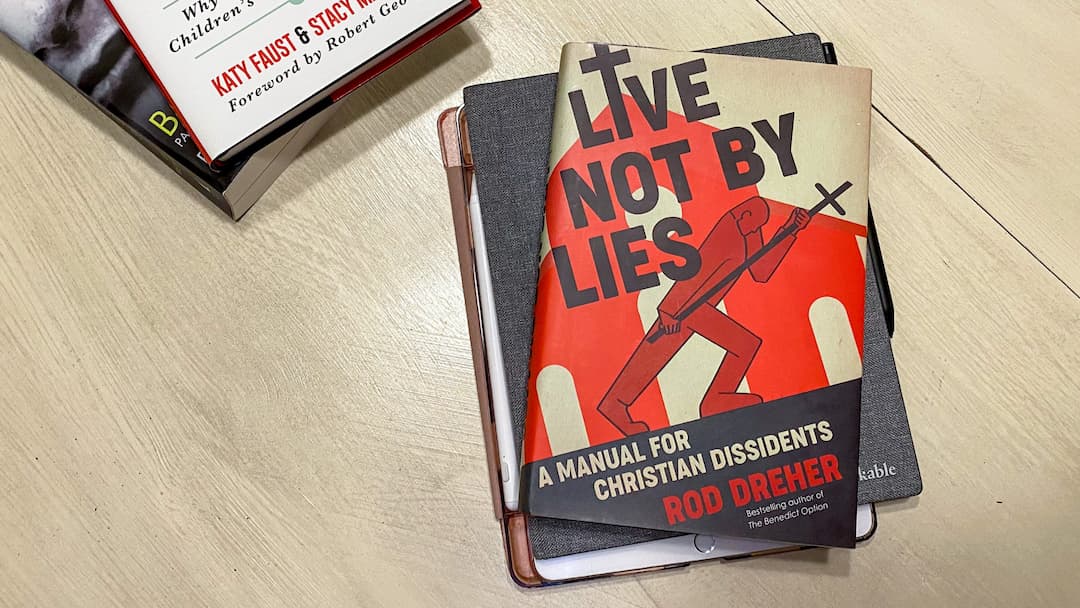
Live Not by Lies: A Manual for Christian Dissidents by Rod Dreher is a great summary of where America is politically, and roadmap for where she is headed. It also provides great encouragement for Christians who are concerned about holding on to their faith in the current and coming political climate.
Dreher does a great job of showing how critical theory leads to totalitarianism and, ultimately, tyranny. He demonstrates how it leads to giving up freedoms one step at a time. And he provides examples from countries and cultures that have walked this road before us.
Part 2 of the book provides testimonies from brave men and women who survived totalitarian regimes with their faith intact, coming out on the other side as heroes. It teaches principles we need to be honing and strengthening now so they are firmly ingrained in us when difficult times come. Many of these principles are directly correlated to how God created us, giving us the tools we need to survive tyranny.
This book is a great addition to a worldview curriculum.
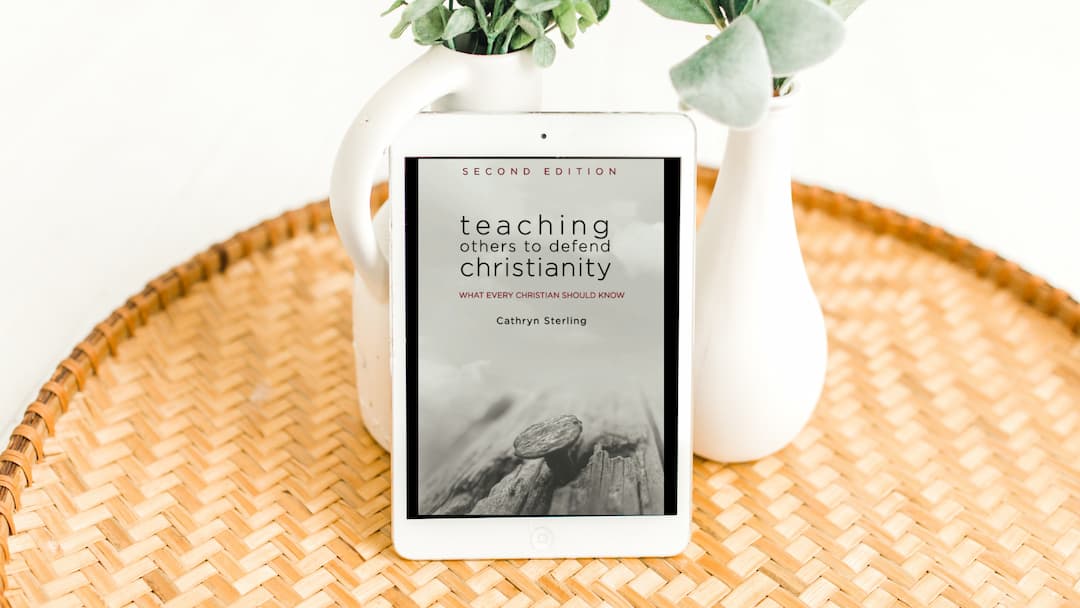
It is a bit more academic than other apologetics books I’ve read, but that is because Sterling takes you through arguments that read like a science book. She explains things like blood clotting to demonstrate how it couldn’t be perfected over time, eliminating the possibility of macro evolution.
In all fairness, I read the chapters out of order for an apologetics class I was taking, so there were times when it felt a bit disjointed.
If you are looking for a source that will walk you through from arguing for a creator all the way through the validity of the New Testament and Christ, this book is what you’ve been looking for.
It would make a great addition to a worldview or apologetics curriculum, too.