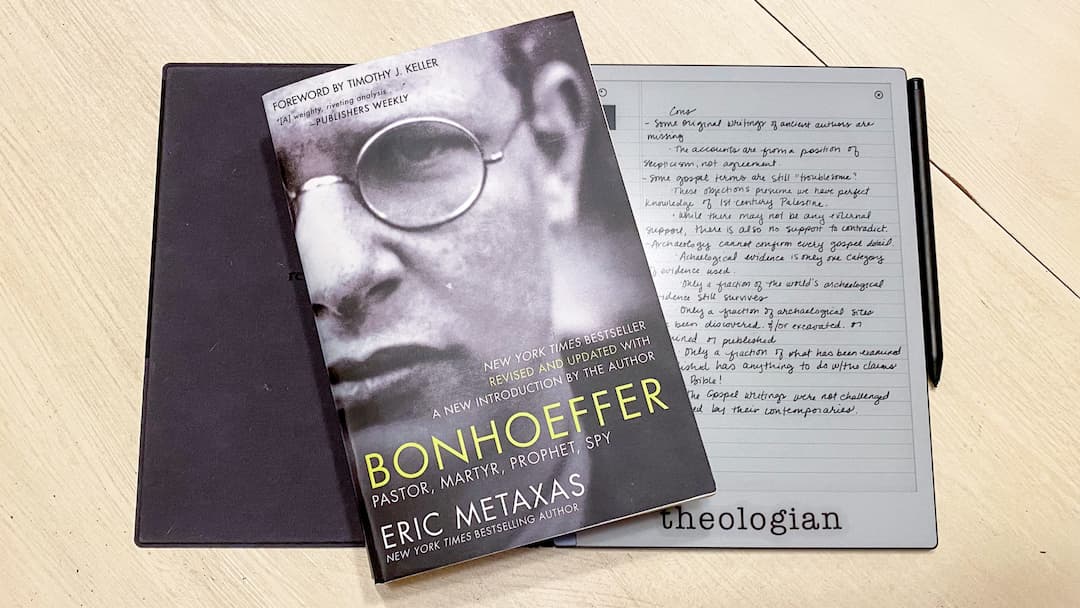
While this book is a biography of Dietrich Bonhoeffer in that it follows his life, it is also a history of Nazi Germany and Adolf Hitler’s rise to power. It is important to remember that the Holocaust was not the beginning, but the end result. There were many steps taken that ultimately ended in the Holocaust, and learning about those steps was sobering as I compared them to things happening in our modern society.
Bonhoeffer was not Jewish. He was from a well-known and respected family. He was an upstanding member of society. And he had the opportunity to stay in America for the duration of the war. He could easily have ridden out the war with little danger. He could have sat on the sidelines. Instead, Bonhoeffer knew that his service to God meant he had to get involved, protect the innocent, and defeat the enemy.
Within the account, Metaxas includes original writings from, to, and about Bonhoeffer. He includes journal entries that give us a glimpse into Bonhoeffer’s thoughts. And he shares the words of those who knew Bonhoeffer best, including those who shared his cell and his fate.
Throughout the book, we see Bonhoeffer recognize evil in many forms. He doesn’t just see the evil of innocent people harmed, but he recognizes the false gospel that was prevalent in the church, and he saw the oppression and division caused by racism in America at the time. He recognized the failing of social justice, and he showed how once good leaders became weak.
Not only is this book a biography and a history lesson, but it is a commentary on our world today. It is a road map for our destination if we do not correct course and do it quickly. This book reinforces the theme I repeat to myself: Live not by lies! Uphold truth at all costs! Without truth as our plumb line, we will be tossed to and fro in the storms of this fallen world.
I remember the moment very clearly. I was driving home from our new business feeling so defeated. Our tax guy had just given us the bad news: We would have to pay $20K in taxes. It might as well have been $1M!
As tears streamed down my face, I recounted all of my failures since we started the business. I had left a career I enjoyed to become a stay-at-home mom and help my husband get the shop off the ground. I discovered I wasn’t a natural homemaker, I didn’t enjoy cooking (and my family didn’t enjoy it, either), I wasn’t gifted at nurturing (I’m more of a “rub some dirt in it” kind of mom), and now I had failed at the business finances. All of my dreams for this transition seemed to be turning to ashes. I remember saying out loud, “Lord, I’m done. I can’t do this on my own. I need help!”
Because I had grown up in a pastor’s home, I knew the Bible. I could win the Bible Trivia games and the sword drills. But when I faced crises in my life, I turned to my dad. My dad was a very godly man, and he gave me great advice, but I should’ve been turning to God’s Word. I think this is a hazard many PKs face. This time, I didn’t have that choice. My dad had started showing signs of Alzheimer’s and could no longer fill that role in my life.
I couldn’t expect God to speak to me if I wasn’t spending time in His Word and speaking to Him through prayer. So I began to read my Bible. I got involved in Bible-reading plans, Bible studies, and conferences. And I found that, as cliché as it might sound, the more time I spent in God’s Word, the more time I wanted to spend in God’s Word. As the Holy Spirit revealed things to me in the Scriptures that I had never really grasped, I began to fall in love with my Bible.
Just to be clear, not every time I sat down to read did I have a hallelujah moment—sometimes those genealogies are hard to get through—but as the knowledge compounded, and as I sought the wisdom of the Holy Spirit, that knowledge shifted to wisdom and discernment. I started to recognize false teachings. I became sensitive to the struggles of those around me. And I became more and more content in my life.
My circumstances didn’t change: I still was not a natural homemaker, my family still didn’t like my cooking, and we hired a new accountant in our business to handle the finances. But I had changed. God’s Word changed me! Hebrews 4:12 says, “For the word of God is living and active, sharper than any two-edged sword, piercing to the division of soul and of spirit, of joints and of marrow, and discerning the thoughts and intentions of the heart.” Because the Bible is “living and active,” we can trust that it can change us and grow us.
Since those days, I have gone beyond using other people’s studies to studying God’s Word for myself. I took bits and pieces from everything I had learned throughout the years, and developed my own Bible study process. It takes time, and it takes effort, but the reward is so worth it. Psalm 14:2 and 52:3 say, “The LORD looks down from heaven on the children of man, to see if there are any who understand, who seek after God.” I want to be seeking after Him when He looks down from heaven!
Because I have fallen in love with the Word, I want to share it with others. I have created a free workbook that outlines my study process. It is a unique process in that you always start at step 1, but you only go as far as you want to go or as your current season of life allows. You can download your copy of the workbook here. And I can’t wait to see what God does in your life through His Word!
Have you ever been on a mountain road? You know the ones where you hold your breath as you go around each curve, just hoping you won’t go off the edge and tumble down the mountain? Nowadays, it is common for those curves to have guardrails. Guardrails won’t stop you if you are coming too fast, but they are a barrier, one more thing for you to hit so you will slow down, bounce off, correct course, and not go off the road.
We often set up guardrails in our lives—a barrier to slow us down and give us a chance to course correct—so we don’t barrel into sin. These guardrails are usually based on our personal experiences, whether we have suffered the consequences of sin, been taught something is wrong, or learned from the mistakes of others.
For example, when it comes to dating, we know the Bible teaches that sex is reserved for the covenant of marriage. In order to protect ourselves and prevent that intimacy before marriage, we might set some rules: don’t spend time alone, don’t kiss, don’t even hold hands. If we follow these rules, we are less likely to end up in bed together. If you felt a conviction to set these rules for yourself in your relationships, then to break them is sin for you.
Another example is alcohol. Scripture tells us not to be drunk with wine. I know there is alot of context to this verse, but it is the verse most often used to support the idea of abstinence from alcohol. I personally do not drink. My grandfather was an alcoholic, so I grew up in a home where there was never a drop of alcohol. I can’t tell you how many times I’ve heard someone say, “you won’t get drunk if you never take that first drink!” That was a guardrail my parents set in our home and one I’ve set for my family now. I have a personal conviction about this guardrail, so if I were to have a drink of wine with my dinner, for me it would be sin.
Here’s the catch: It is my guardrail, my conviction, so while it would be sin for me, it is not sin for every believer. I can’t hold others to the guardrails I have set for myself.
The guardrails we establish in our lives are good. In most cases, the guardrails are prudent, so it is easy to expect every Christian to implement them. But we can’t hold other Christians to our personal convictions, the ones not given in Scripture. Where there is room for interpretation, we must allow for Christian liberty.
In fact, this is what the Pharisees did. For example, the commandment given by God was to honor the Sabbath and keep it holy. Through the years, rules (guardrails) were put in place to keep the Israelites from breaking that commandment. The rules against working on the Sabbath got so detailed that you could only travel a certain distance, and you could go no further. This would be the equivalent to limiting the number of steps you could take on that day. Over time, these guardrails became the standard instead of the spirit of the Sabbath law. This went so far that the Pharisees attacked Jesus for healing the sick on the Sabbath.
Holding others to a standard we set is legalism. Legalism isn’t speaking the truth of Scripture; it isn’t holding to the “rules” given by Jesus and the apostles; it isn’t dressing modestly, waiting until marriage to have sex, or going to church every week. All of these are clearly stipulated in the Word. Legalism is adding to Scripture and expecting others to abide by our guardrails.
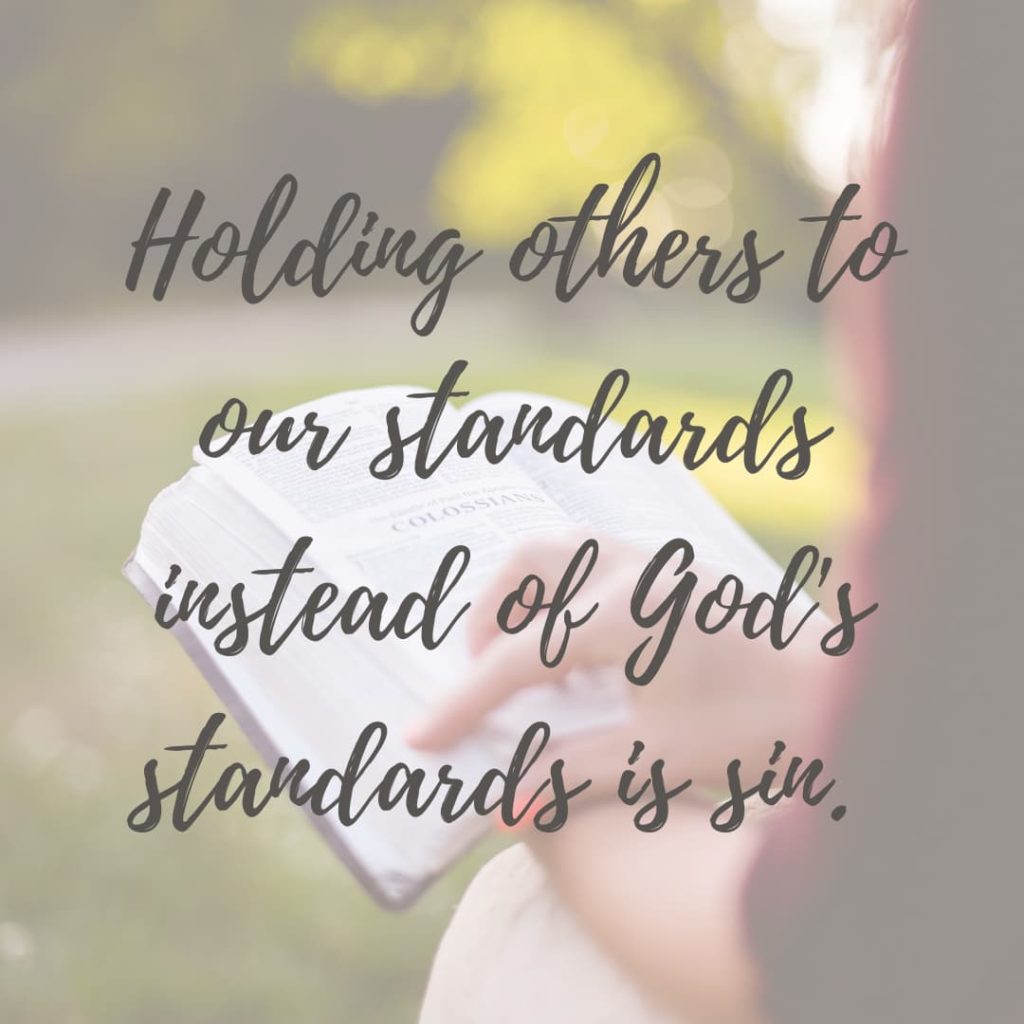
Because our guardrails are based on our personal experiences, we feel very strongly about them. It can feel like a personal affront if someone else doesn’t honor our guardrail. But holding others to our standards instead of God’s standards is sin.
I encourage you to examine your convictions and determine which ones are biblical and which ones are guardrails you have set to protect yourself. You might find you’ve been more legalistic than you thought!
Let me begin by saying the topic of civil disobedience is not a simple topic. On this topic the same arguments can be made for both sides. Our goal in these conversations is not to be right but to be righteous: not to find Scripture that supports our position, but to allow Scripture to inform our position, to see the issue at hand through the lens of God’s Word and take the position that aligns with His will. This is the very reason freedom should be the point upon which we agree.
This post is not an attack on anyone’s personal choice, but it is a commentary on what the government is doing in the current culture and how Christians should respond. Also, I have heard pastors preach sermons like the one I mention in this post across denominational and religious lines, so this is not an attack of a specific pastor, church, or denomination.
I recently listened to yet another sermon on the Christian and civil disobedience which implied we have no reason to rebel at this particular time in history. This sermon left the impression that true Christians will obey the government mandates because they don’t force us to break God’s law. I say it left the impression because in reality, the sermon was vague, as are many. These sermons tend to get muddy because they draw on biblical examples of civil disobedience while at the same time stating that civil disobedience is wrong.
Principles for Civil Disobedience
The following principles are generally listed as the rule of thumb for the believer when it comes to civil disobedience. We can rebel if:
The government commands what God forbids, or
The government forbids what God commands.
This seems pretty simple until you realize that much of what we are facing is not explicitly addressed in Scripture. The Bible doesn’t tell us if wearing a mask is a sin or not. The Bible doesn’t mention vaccines. The word “abortion” does not appear in Scripture. And there is certainly no reference to #freedomconvoy2022. But just because something isn’t explicitly mentioned doesn’t mean we can’t apply lessons we learn from biblical accounts.
The Conscience and Civil Disobedience
A popular argument in favor of civil disobedience is the idea of conscience. We will say things like, “that goes against my conscience, so I can’t do it.” It is important to remember that our consciences must be molded and guided by the Word of God. Many will say that there is no room for conscience in this conversation. If your conscience is telling you not to obey the government, then your conscience is wrong because we are told over and over in Scripture that God has placed those in authority, and we are to submit to them (Romans 13:1-7, Titus 3:1, 1 Peter 2:13, etc.). But the truth is that if your conscience has been molded by the Word, if you are spending time with God regularly and are studying the Scriptures, your conscience can play a valuable role in your decision making.
Biblical Examples of Civil Disobedience
Several examples from Scripture are used to show when civil disobedience is appropriate. Usually, these examples are used to show the extreme cases presented. In Exodus 1, Pharaoh orders the killing of all of the male, Jewish babies. The midwives did not comply. In Daniel 3, we read about Shadrach, Meshach, and Abednego, who were told to worship Nebuchadnezzar’s idol. They did not comply. In Daniel 6, we read the account of Daniel’s decision to pray even though it was against the law. These are all examples of when the government commanded something God had forbidden, or forbade something God had commanded.
Let’s pull these examples into modern day.
The midwives didn’t kill the Jewish baby boys because they understood that life is sacred. Our government wants to use the tax money we are required to pay to fund abortions, thus negating the sanctity of life. This is grounds for civil disobedience.
Shadrach, Meshach, and Abednego did not bow down to the idol because God forbids idol worship. We are to worship only God (Exodus 20). But idol worship is not limited to carved, golden statues surrounded by a shrine and lit candles. An idol is anything that takes the place of God, anything we trust more than we trust God, anything we fear more than we fear God. Our society has turned Covid and the vaccines into idols. The authorities have destroyed jobs, livelihoods, childhoods, and futures in order to force everyone to bow down. Let me remind you, this is not a statement about your choice but about what the government is doing. The government is pushing us to worship at the altar of Covid to the god of Fauci. This is grounds for civil disobedience.
Daniel broke the law when he prayed to God as he had always done. And he would’ve paid with his life had God not intervened. There is such a thing as an unjust law. It is unjust for parents to lose custody of their children because they choose not to get vaccinated. It is unjust to refuse a life-saving medical procedure because the patient is not vaccinated. It is unjust to force children to spend eight hours a day behind a mask because adults are scared of illness. It is unjust to discharge military personnel who have pledged their lives to protect our freedom because they made the “wrong” medical decision. When we allow unjust laws to go unchallenged, we quickly decline into tyranny and genocide. This is grounds for civil disobedience.
Truth and Fear
Think back to what you know about our own American revolution. It could be argued that England, the authority over America at the time, was not commanding something God forbids or forbidding something God commands. On paper at least, it came down to taxes. Yet no one argues that America should not have fought for her independence because we all know it was about something much deeper than taxes. Much like today, when our conflict is about something much deeper than a mask or a vaccine.
The Bible is clear that Christians are to speak truth and live in truth no matter the consequences. Our current authorities want us to refrain from speaking truth in many areas of life. They want us to lie about the efficacy of masks, about the potential side-effects of vaccines, about the moment life begins, about biology, about “race,” and the list goes on and on. This is grounds for civil disobedience.
Scripture commands us over and over again that we are not to live in fear. The King James Version uses the phrase “fear not” 365 times, but the idea is present in the Word much more often. Our governing authorities want us living in fear. We are to fear Covid, fear our neighbors, fear killing our relatives, fear the loss of our livelihoods, fear not going back to “normal,” fear shortages, etc. This is grounds for civil disobedience.
In the most recent sermon I heard, the preacher made the statement that “the difference between the revolution in England and the revolution in France came down to the presence of Christians.” Yet he implied that Christians should stand down. He claimed that Christians in England kept the revolution from devolving into a bloody massacre, yet he urged Christians now to stay out of the fight.
Our churches should be leading the charge to stand up for truth. When governments are requiring things that fly in the face of truth, it is grounds for civil disobedience.
Do you choose a word for your year? I began choosing a word for my year about 5 or 6 years ago. Before that, I never really understood the point. And, honestly, I don’t think it is the most important thing I can do as I prepare for a new year even now. But for the last several years, I have chosen a word, not as a goal for my life like “success” or “wealth,” but as a focus for my year to make sure I’m pursuing things that are true, honorable, just, pure, lovely, commendable, excellent, and worthy of praise (Phil. 4:8).
For 2021, my word was “bold humility.” I wanted to make sure that, as I shared ideas on social media and in my blog, I was doing it for the right reasons and in the right way. In 2020, my word was “cultivate.” I had just finished reading a book by that title written by Lara Casey and had a strong desire to cultivate relationships and a peaceful atmosphere for my family in our home. Other words I’ve claimed in the past include “undeserving,” “savor,” and “thrive” (this one was chosen our first full year of homeschooling, and I wanted it to be more than surviving).
A couple of important things to point out are 1) I am not trying to “manifest” anything into existence. I’m using the word to make sure I focus on the things I’ve made a priority—my spiritual walk, my family, my relationships. And 2) at any point in the year, my word can change. It is there as a reminder to me, not as a strict, unbending yard stick but as a flexible guideline.
If you come from a New Age background, and manifestation and the law of attraction are stumbling blocks, this may not be the best practice for you. And if you love this idea, but you can’t decide on one word, feel free to choose as many as you want! Maybe you want a different word for different areas of your life. That’s ok. There are no rules.
My word for 2022 is “dwell.” As I read through the Bible in 2021, the word “dwell” jumped off the page for me time and time again. Even my pastor has focused in on it during his sermons. I want to dwell in Scripture this year. I want to dwell in my prayer time. I want to dwell with my family and not be distracted. I want to dwell with the ladies at my church as we grow in Christ together. I want to dwell with my friends from all different circles in my life. To be present—that’s my desire.
If you decide to pick a word for 2022, I’d love to know what it is.