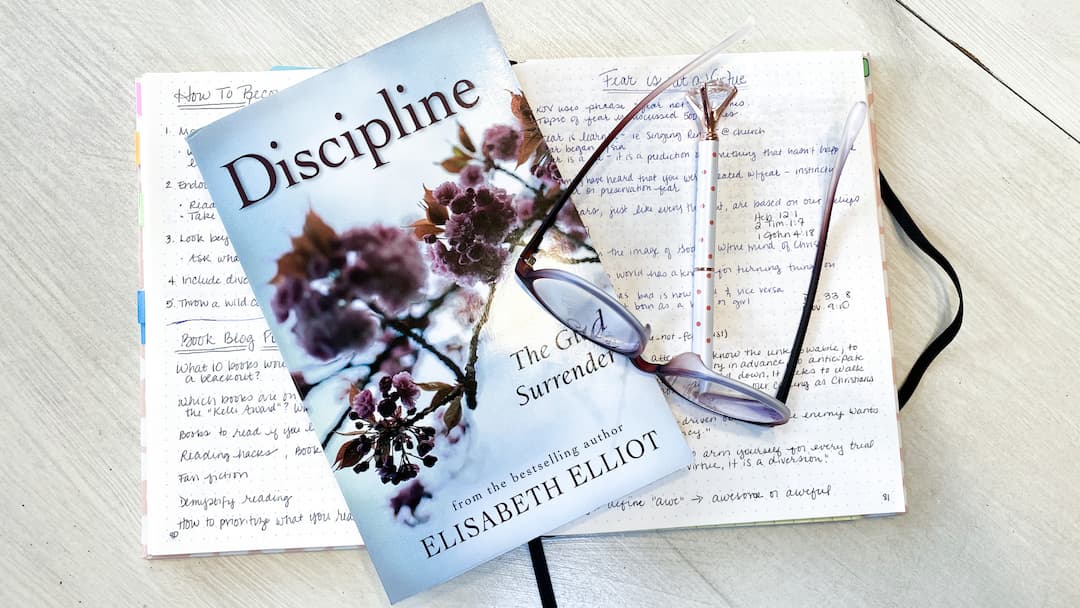
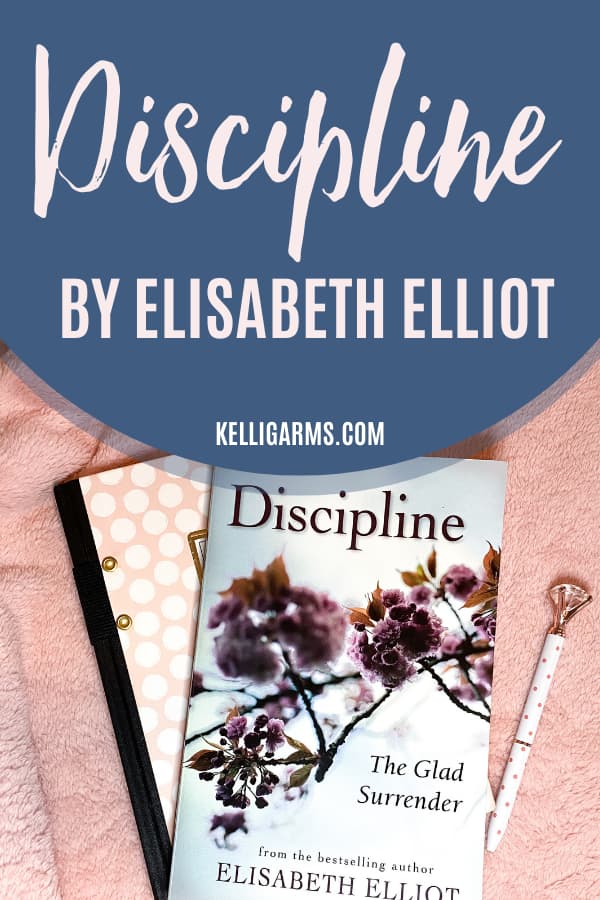
Recently, I read Elisabeth Elliot’s book Discipline: The Glad Surrender. What a treasure trove of wisdom Elliot was, and her books continue to encourage Christian women around the globe! This book is no exception. While a struggled a bit with her style in the beginning, I finished the book with a renewed sense of purpose.
Elliot encourages us to live a disciplined life, one which is completely surrendered to God. She leaves no area untouched as she speaks to the discipline of our inner world as well as our outer world. In the book, Elliot addresses our body, time, possessions, mind, work, and even our feelings. Leaving no room for argument, Elliot gently pushes us to be better—better at worship, better at productivity, better at life, and better at walking with Christ.
Below, I have listed my favorite quotes from the book. Somehow, I was able to cut the list down to fifteen quotes. They are in the order in which they appear in the book. After reading these quotes, I have no doubt you’ll feel compelled to read the book for yourself. Therefore, I am not offering any explanation with the quotes but am simply listing them as she wrote them. Enjoy!
To learn more about Elisabeth Elliot, check out this website.
Top 15 Quotes in Discipline: The Glad Surrender
“If I trust Him, I will obey Him gladly” (12).
“The unwillingness to be obedient is a violation of our humanity” (16).
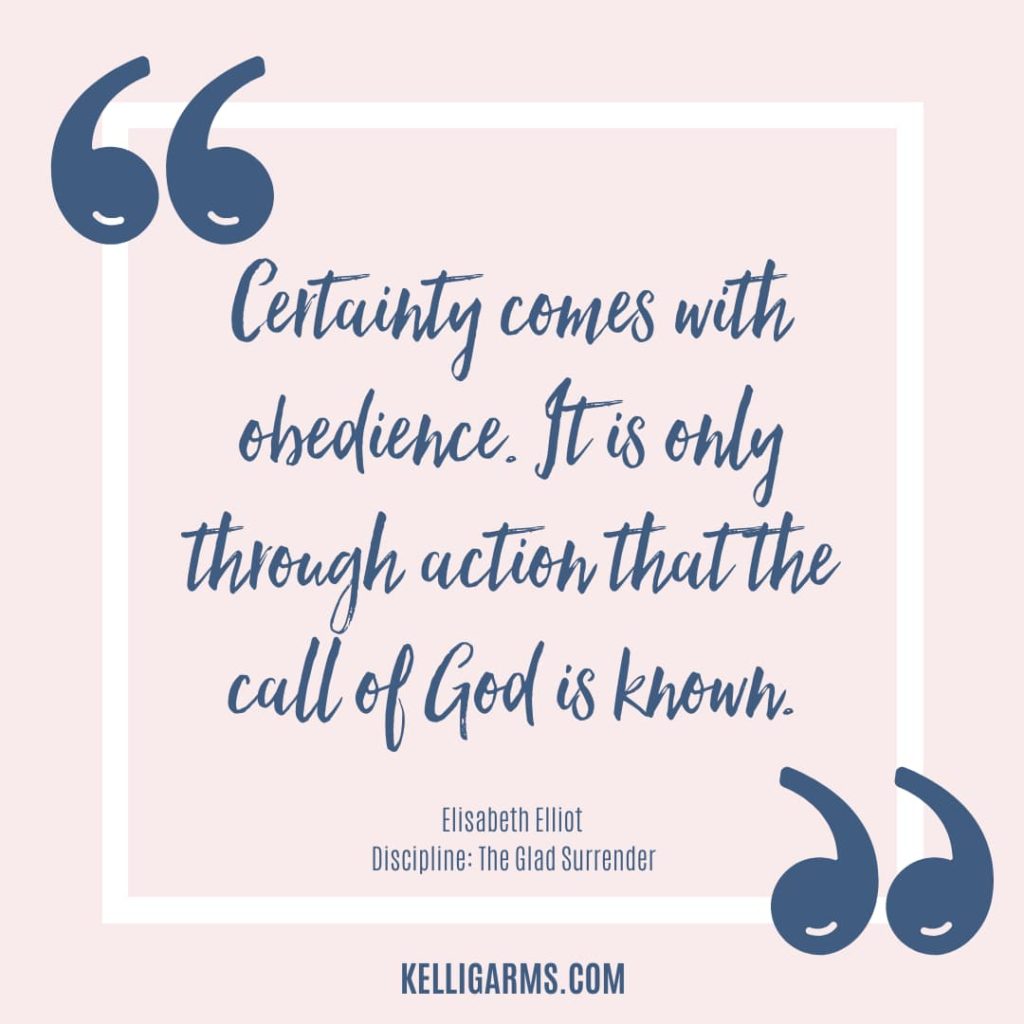
“Certainty comes with obedience. It is only through action that the call of God is known” (18-19).
“Discipline is not my claim on Christ, but the evidence of His claim on me” (27).
“He expects us to work, just as the designer of a precision instrument, if he understands the principles involved and designs it accordingly, expects the thing to work. It is no great credit to the instrument if it does” (30).
“Noah’s willed action and his faith went hand in hand. We see again that faith is a far cry from feeling or religious mood. It is not vague. It hears the Word of the Lord, and it acts. ‘If it does not lead to action, it is in itself, a lifeless thing’” (34).
“When the will of man acts in accord with the will of God, that is faith. When the will of man acts in opposition to the will of God, that is unbelief” (35).
“If we hold back our obedience until we have plumbed the theological depths of this mystery, we shall be disobedient. There are truths that cannot be known except by doing them” (38).
“The Bible does not explain everything necessary for our intellectual satisfaction, but it explains everything necessary for our obedience and hence for God’s satisfaction” (41).
“There is a common belief that a frank expression of what one naturally feels and thinks is always a good thing because it is ‘honest.’ This is not true. If the feelings and thoughts are wrong in themselves, how can expressing them verbally add up to something good? It seems to me they add up to three sins: wrong feeling, wrong thought, wrong action” (63).
“Christianity teaches righteousness, not rights. It emphasizes honor, not equality. A Christian’s concern is what is owed to the other, not what is owed to himself” (81).
“Frustration is not the will of God. Of that we can be quite certain. There is time to do anything and everything that God wants us to do. Obedience fits smoothly into His given framework. One thing that most certainly will not fit into it is worry” (101).
“People wish they had more leisure time. The problem is not too little of it, but too much of it poorly spent” (102).
“There is no such thing as Christian work. That is, there is no work in the world which is, in and of itself, Christian. Christian work is any kind of work, from cleaning a sewer to preaching a sermon, that is done by a Christian and offered to God […] A Christian finds fulfillment not in the particular kind of work he does, but in the way in which he does it” (118).
“Let us be honest in recognizing feelings and honest enough to reject them when they are wrong” (143).
At 44 years of age, I have started noticing that the skin around my eyes doesn’t bounce back like it used to (Ok, I’ve been noticing this for a while now). My eyeshadow settles in the creases of my eyelids, and my concealer can end up highlighting the fine lines under my lower lashes. MONAT has a solution. The Eye Smooth from MONAT’s skincare line rejuvenates and hydrates the fragile skin around the eyes.
Eye Smooth brightens and smooths the skin to give you a more youthful look. It lightens the dark circles under your eyes, it relieves the puffiness, and it minimizes the appearance of fine lines and wrinkles around your eyes. It comes with a rose gold eye roller for added results. The cooling effect of the eye roller is refreshing, and it helps you make sure the cream is fully absorbed into your skin.
Eye Smooth Targets
Fine lines and wrinkles
Dark circles
Puffiness
Under-eye bags
Crow’s feet
Dryness
How To Use Eye Smooth
For best results, use the Eye Smooth cream in the morning and in the evening. The opposite end of the eye roller is a spatula you can use to remove a very small amount from the jar and apply it to your ring fingers. Using your ring fingers (because they are your weakest fingers so they won’t tug on your fragile skin as much), gently tap the cream under your eyes. Glide the eye roller around your eyes until it is fully absorbed into the skin.
Eye Smooth Key Ingredients
Rejuveniqe S: MONAT’s proprietary blend of 17 botanical oils and extracts.
Peptide: Helps support the skin’s natural collagen.
Plant Stem Cells: Antioxidant protection against environmental elements.
Plant-Derived Squalane: Adds maximum moisture and conditioning to support the elasticity and smoothness around the eyes.
Caffeine: Wakes up the eyes, giving them a well-rested effect.
The book of Genesis is chock full of amazing history! In it we learn the stories of creation, the flood, the origin of the Jewish nation, the coat of many colors, and so much more. But sometimes these stories can seem disjointed, out of order, or lacking in detail.
Some of the narratives raise questions they never answer, like where did Cain get his wife? Sometimes they seem to speed through the story, like when it relates the birth of all of Jacob’s children in a short chapter. And other sections seem to come out of order or go back to a previously mentioned detail, like in the account of the creation of mankind.
Genesis Is a Historical Narrative
When we read the book of Genesis, it is important to remember that this is not a first-hand account told as the events unfold. The stories of creation, the fall, Noah’s ark, the Tower of Babel, and even the covenant God made with Abraham were passed down from generation to generation orally until Moses wrote them down for the Israelites during their long trek through the wilderness. Moses gave us the necessary information to understand the point of the story, not to know every little detail pertaining to it.
While this doesn’t affect the credibility of the book (Moses was chosen and inspired by the Holy Spirit to write down these exact words), it does affect the style. We have grown accustomed to a narrative style that keeps things in order and explains the details. But can you imagine how long the Bible would be if that is how it was written?
Genesis Is Not a Textbook
It is also important to realize that Genesis is not a history book, nor is it a science textbook. It contains history, and it contains science, but it is not meant to be read for the sake of gaining knowledge. It is interesting, however, that the archaeological community continues to find artifacts that support the historical narrative of Scripture, and the scientific community regularly “discovers” things the Bible has already told us. But that is a topic for another time.
Moses wrote down exactly what God knew we needed to know, and he left out exactly what God knew we didn’t need to know. So, while it can be fun to follow a rabbit trail and do the math to figure out exactly how many years passed from the time of creation to the flood (I’m a nerd, I know), don’t get so wrapped up in the missing information that you can’t learn what God wants to share with you.
Genesis Is about God
When we read the book of Genesis, we need to remember, first and foremost, that the Bible is a book about God. The purpose of the whole Bible, including Genesis, is to teach us who God is. When we read the Bible for that purpose, our perspective changes.
When we read Scripture to discover more about God, it teaches us more about us, too. When we see ourselves in light of who He is, we recognize who we are. While we are God’s image bearers, we are also sinful creatures. This is demonstrated through the people in the stories of Genesis. While it is tempting to put different characters on a pedestal and want to be like them, Scripture doesn’t sugar-coat their stories, and it allows us to see all of the pitfalls and temptations they faced as well as their victories.
So, as you approach the book of Genesis, do so with the intent to know God. What does the story of creation tell you about God? What does the flood teach you about His character? What does His covenant with Abraham tell you about who He is? Our goal should be to fall deeper in love with Him while we read the fascinating stories included in Genesis.
This fallen world has a knack for turning everything on its head: what was bad is now good, what was wrong is now right, 2+2 no longer equals 4, and fear has become a virtue.
Before 2020, it was common for me to see several posts per day in my social media feeds telling me to “do it scared,” “rise above the fear,” or “let your faith be bigger than your fear.” I noticed a dramatic decrease of those pretty graphics around the same time the lockdowns began. It seems like we have accepted fear as our “new normal” instead of something we need to work through, rise above, or defeat.
Origin of Fear
As Christians, it is important for us to understand the origin of fear. Some teach that fear is innate; we were created with a “fight or flight” response that was intended to protect us from predators. But that’s not what the Bible teaches.
Man was not created fearful. Man was created and placed into a perfect world where there was nothing to fear—no natural disasters, no illness, no violence.
When you read Genesis, you discover that all of the animals (and humans) were vegetarian, so they didn’t hunt each other. Rain did not make its appearance until the flood. And think about the fact that Eve was not startled by a talking snake. There was nothing to fear in the Garden of Eden. And then man sinned.
Fear Began at the Fall
The first time fear is mentioned in Scripture is after the fall. Adam heard God in the garden, and he was afraid. God had never given Adam a reason to fear Him, yet once Adam sinned and realized he had broken God’s one command, he was afraid. Fear is a result of sin, and fear is learned through our experiences.
Fear Is Learned
Children are fearless. They have to be taught to steer clear of campfire flames, be careful with sharp objects, and back away from steep drop offs. Fear is not innate; it is learned through experiences. Even a child’s fear of the dark doesn’t begin until she has seen or heard something that causes the fear.
The same can be said for adults. Our fears come from our past experiences or what we have learned. There have been times when friends have expressed a fear that seems ridiculous to me, not because I think my friends are ridiculous, but because I haven’t shared their experiences, and therefore do not share their fears. And there have been times when I have shared a fear that seems completely unfounded to my listeners.
Fears, like every other thought, are based on our beliefs. In fact, analyzing our fears is a great way to nail down what we actually believe. Do we really believe God is in control? Do we truly believe our days were numbered before we were even conceived? Do we really believe all things work together for God’s glory? Or do our fears contradict what we claim to believe?
I can honestly say I have been challenged in this area lately. I found that my anxiety was overwhelming me even though I have never been a naturally anxious person. I was consuming too much of the world, and my fears were reflecting beliefs I didn’t realize were taking root.
Fear Is a Lie
Let me be clear: your feelings of fear are real, but the object of your fear is a lie. Fear is based on a prediction of something that hasn’t happened yet, and may not happen at all. We think we can foresee an outcome based on past experiences, and while this may be true when it comes to touching a hot stove, it cannot be applied to our circumstances.
Whether I’m afraid of illness, suffering, loss, embarrassment, or any number of other things, the fear is me trying to predict the future based on past experiences, not truth. And my goal in that fear is to protect myself, yet I have no control over anything that happens.
My friend, Anneliese said it this way: “Fear is the frantic attempt to know the unknowable; to defend oneself from adversity in advance, to anticipate the worst and never let one’s guard down. It seeks to walk by sight in direct contradiction to our calling as Christians to walk by faith” (@feminine_not_feminist on Instagram).
How To Overcome Fear
The King James Version of the Bible uses the phrase “Fear not” 365 times, but the topic of fear (and similar ideas) is discussed in Scripture more than 500 times. We are told in 2 Timothy 1:7 that “[…] God gave us a spirit not of fear but of power and love and self-control.”
In the verse right before that, Paul tells Timothy to “fan into flame the gift of God.” We can overcome fear by focusing on “fanning into flame the gift of God” instead of dwelling on our fears.
You might be thinking it is impossible to control your thoughts. The fears are there whether you want them or not. But your mind cannot multitask. It cannot focus on two things at the same time. So when you find your thoughts turning to fear, you can steer your mind to other things instead.
What you dwell on, grows. What you consume is what you will produce. Choose to consume and dwell on the things of God, so those things will grow.
When I noticed my anxiety levels rising, I had to attack the false beliefs of fear with the Truth of Scripture. I memorized Scriptures that I would recite when I felt the fear gripping me. When I focus on the verses I’m quoting, my mind can’t think about the fear.
1 John 4:18 says, “There is no fear in love, but perfect love casts out fear.” Since love and fear can’t coexist, use moments of worry, fear, and anxiety to remind you about the people you love, to push you to develop your love for Jesus, or to plan something for your spouse or children. Rather than allowing your fear to drag you down, use it as a trigger to better love those around you.
Why We Hold On to Fear
It might surprise you to realize that fear makes us think we have control. We hold on to our fear because it gives us the sense that there is something we can do to keep ourselves and our loved ones safe or comfortable. It convinces us that we know the best course of action to take.
But 1 Peter 5:6-7 says to “Humble yourselves, therefore, under the mighty hand of God so that at the proper time he may exalt you, casting all your anxieties on him, because he cares for you.” You are invited to give up your fears and lay them at the feet of Jesus, but it takes humility. It takes giving up the semblance of control. It takes acknowledging your weakness. Are you willing to do that?
“God invites you to hope-driven obedience. The enemy wants fear-bound stagnancy” (Anneliese).
Don’t let the world define your “normal.” Christ came to give us abundant life (John 10:10), not a life of fear. Scripture challenges us to overcome our fears, set our minds on things above, and lean into the knowledge that we are known and loved by our Creator!
Do you struggle with split ends? There are many causes for this annoying predicament including styling with heat, treating with chemicals, and even brushing or combing your hair. Unfortunately, split ends are rather unavoidable. But MONAT has a product that mends those pesky split ends!
Rejuvabeads by MONAT
Rejuvabeads targets and heals damaged areas of the hair shaft, including split ends. This helps to eliminate frizz, breakage, and friction while increasing shine and improving color. The hair is stronger and more manageable. And the effects of the Rejuvabeads last through 2-3 washes, and improve with each use without causing build-up or heaviness. It also protects the hair from further damage from styling or treating.
The key ingredients of Rejuvabeads include Rejuvenique, a proprietary blend of 13 natural oils; linseed from flax; and chia seed extract full of anti-oxidants and omega-3 fatty acids. Ingredients you will NOT find in Rejuvabeads include phthalates, sulfates, paragons, harsh salt systems, harmful colors, harmful fragrances, PEG, or DEA/MEA.
How To Use Rejuvabeads
Work product through your clean, wet hair from mid-shaft to ends with hands or a wide-toothed comb. Let the product absorb for a full minute before applying any other products or styling.
Bonus
This month, when you place a flexship order or sign up as a VIP customer, you can receive a travel-size Rejuvabeads free with your order.
If you would like to see which products are best for you, click here to take the beauty quiz or send me an email with your questions at [email protected].