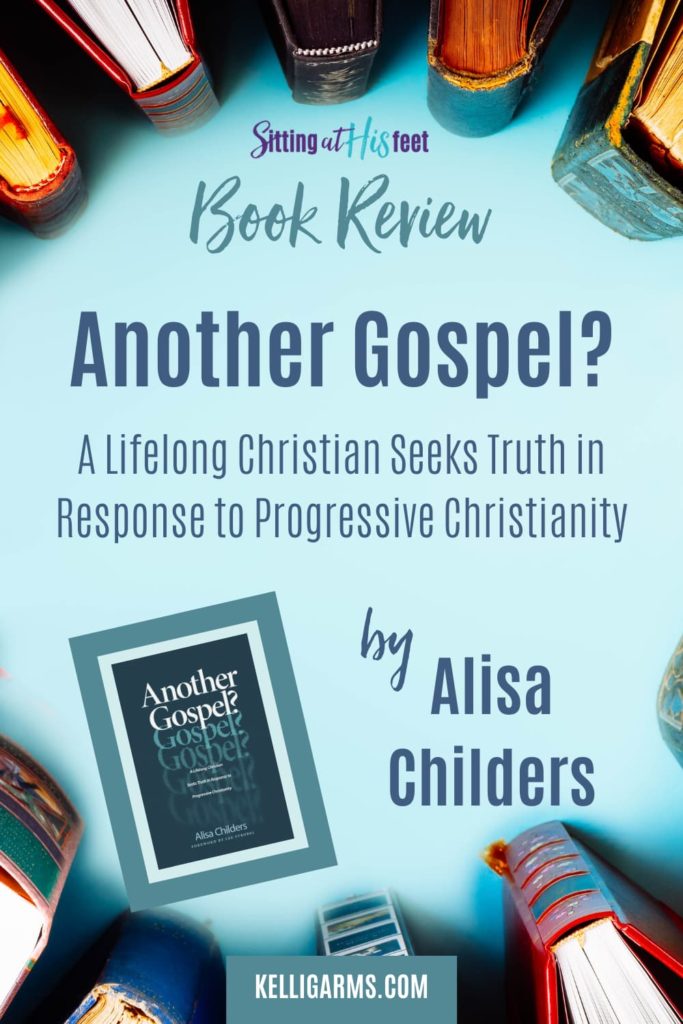
Alisa Childers tackles the difficult questions that led to the deconstruction of the Christian faith and created progressive Christianity.
Have you ever heard someone say that most of what we learn is “caught not taught”? I’ve come to realize this is how a lot of us have seen discipleship. Rather than explicitly discipling, teaching detailed apologetics, or even catechizing kids in the at at home or in the church, we hope they will “catch” enough Bible teaching to hang in there when it gets tough. Or maybe we think as long as they are saved, that’s good enough. As a result, we don’t prepare them for the questions, from others and from their own minds, that will come one day. Certainly, living out what we believe for them to see is beneficial, but we have to know what we believe before we can live it out. There must be some teaching to support the “catching.”
Having grown up a pastor’s kid, many took my discipleship as a given. It was assumed that not only did I know what I believed, but also I knew why I believed it. While it’s true I knew what I believed, and I could answer all of the Sunday school questions, I wasn’t prepared to answer those who would question the truth of Scripture itself, the source of my spiritual confidence.
“…biblical faith is not a blind leap; it involves knowledge—that God has spoken and is trustworthy.”
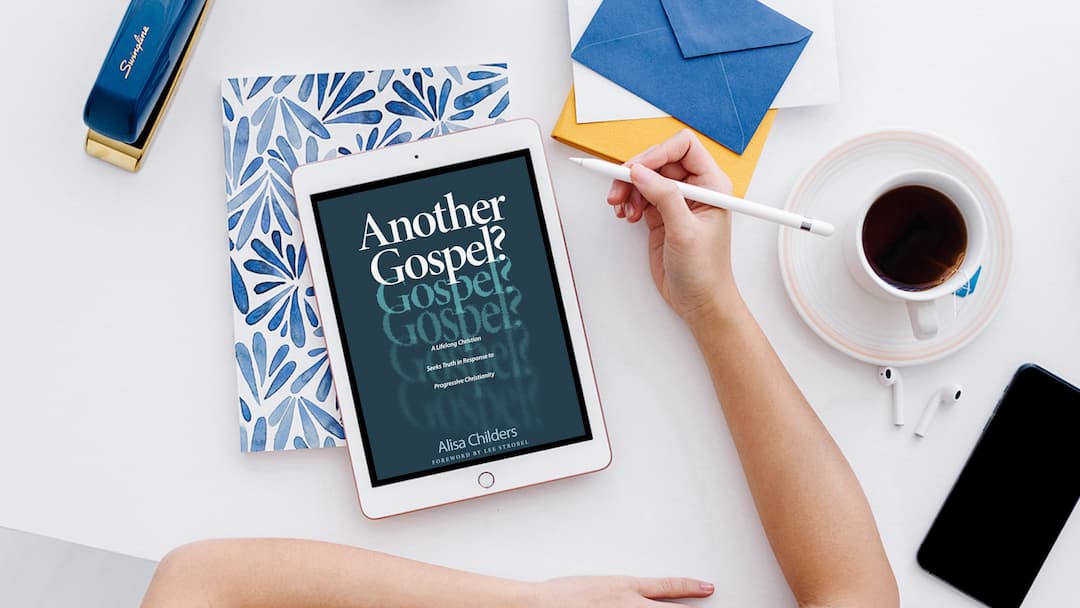
Reading Alisa Childers’s book, Another Gospel? A Lifelong Christian Seeks Truth in Response to Progressive Christianity, showed me I was not alone in this. Not only does she address questions with which I have wrestled–like what if Christianity was made up by a bunch of guys to see how many people they could fool?–but also she provides lengthy lists of sources so her readers can continue their research. Her presentation of the facts and evidence to support her position is thorough yet easy to read.
Childers addresses the progressive movement specifically in her book. This movement raises ideas that use the language of Christianity but originate from a questioning of what Christianity really is. They call into question the dependability of Scripture, the character of God, and the historical teachings of the Christian church. While we might be prepared to answer those who are outside the faith, we face increasing difficulty answering the questions raised by those who may know our Bible better than we do and call into questions things we have accepted at face value.
“… the Christianity I had known was deep and real and true. It wasn’t soiled by legalism or hypocrisy, ravaged by abuse, or oppressed by doubt. I wanted to progress in my faith…in my understanding of God’s Word, my ability to live it out, and my relationship with Jesus. But I didn’t want to progress beyond truth.”
Childers relates the events that took place in her own life when she was under the leadership of a progressive pastor. The process began as it usually does, with deconstructing her Christian beliefs. She defines deconstruction as “the process of systematically dissecting and often rejecting the beliefs you grew up with.” While many end the process and walk away from their faith during this phase of the journey, Childers set out to reconstruct her beliefs and find out the truth.
The questions Christians ask answered in her book:
Alisa Childers tackles the hard questions that led to the deconstruction of the Christian faith and created progressive Christianity.
What did the first Christians believe about Jesus?
What did they believe about the Scriptures?
How do we know the books in the Bible are the right ones?
Where did sin come from, and can we ever overcome it or should we even try?
What is critical theory, and what influence does it have on Christianity?
Is there absolute truth, and how do I know when I’ve found it?
How reliable is the Bible?
Does it contain any errors?
How do we recognize false teaching?
Is the Bible really God’s Word?
Is hell real?
If so, what is hell like?
Does God really send people to hell?
Why did Jesus really have to die, and who killed Him?
How can God be love and wrath at the same time?
How should a Christian handle same-sex attraction?
And so many more!
Many of these topics overlap and interconnect, so they come up over and over again in different chapters of the book. Childers tackles these difficult topics and admits when it is uncomfortable and even unpleasant. If you have ever asked any of these questions, this is a helpful resource to firmly know what you believe, why you believe it, and how to defend it.
By taking the reader back to the earliest Christian creed, helping navigate through history in the early church, and working systematically to explain each question and answer, Childers builds a foundation for a steady and solid faith. When I finished reading the book, I felt better prepared to defend my faith and answer the hard questions. It added “meat” or substance to areas where my knowledge was minimal.
Childers shows how the false teachings have infiltrated the Christian church and teaches how to recognize them. She defines the terminology that is common in the different progressive teachings and warns about subtle attacks. Ultimately, Childers proves that the false teachings give no answers and no hope.
“…progressive Christianity offers me nothing of value. It gives no hope for the afterlife and no joy in this one. It offers a hundred denials with nothing concrete to affirm.”
The depth and breadth of her research is impressive, but she manages to keep the tone and style of the book very clear and straightforward. While the book is rich with content, it was a quick and easy read, which is good for me because I will read it again and again!
Find Christian Author and Apologist Alisa Childers
I can’t tell you how many times I have planned to read the Bible all the way through only to be derailed when I hit the book of Leviticus. What makes the book difficult is the detailed steps of sacrifices, instructions for handling dead bodies, and lists of clean and unclean animals and activities. As Christians, we know we are supposed to read all the parts of the Bible because it is God’s love letter to humanity, but it can be hard to push through.
This year, when I got to Leviticus, I armed myself with some tools. Not only did I make it through the book, but I actually enjoyed it and finished the book with a deeper understanding of its value and importance. Now I want to share those tools with you. These tools are not in any particular order.
Pull Back on Application
It is a pretty modern idea that knowledge is pointless without application. This has brought on a trend of trying to apply every passage we read in the Bible to our lives at this moment. The applications seem to come easily when we are reading Paul’s epistles, but Leviticus is a little harder to apply. Because it contains laws for sacrifices and rituals we don’t practice today, it can seem pointless for us to put in the effort to understand the book.
But our purpose in reading the Word is not application. I’m not saying it doesn’t apply to our lives, but that should not be our focus. We should be reading the Bible to get to know God. As we read through any book of the Bible, we should be looking for clues about God’s character.
In Leviticus, we should be looking specifically for God’s holiness, His mercy, and His grace as He provides a way for Him to dwell among His people.
Consult a Bible Handbook or Study Bible
Because there are many laws that seem so strange to us, a Bible handbook or the notes in a study Bible can be very helpful as you make your way through the book of Leviticus. You could also use a website like blueletterbible.org (also available as a free app) if you don’t have a study Bible or simply want another tool.
You need to find basic information like who wrote the book? When was it written? To whom was it written? What time period does it span? The answers to these questions will hopefully spur other questions and clarify some things as you get into the book. When you come to a confusing passage, use the notes in the handbook or study Bible to find clarification. Often the explanation is simple but foreign to our modern, western culture.
One of the interesting details you can learn from a tool like this is that the title of the book means “things concerning the Levites.” This makes sense as you start reading about the sacrifices and the feasts over which the Levites preside. You can also use these tools for word study, which takes us to the next tip.
Define Your Terms
There are repeated terms in the book of Leviticus that need some context because we might understand them differently today than they were meant when written or translated. There are also words we need to define because they are words we just don’t use in everyday conversation. Understanding these terms can change the way we read the passage.
Many Christians struggle to get through the book of Leviticus. Here are a few tips to help you stay engaged as you tackle this book.
For example, the terms “clean” and “unclean” that show up repeatedly in Leviticus have nothing to do with hygiene or being dirty. Most times they don’t even refer to sinfulness. Instead, they refer to a ritual state. In other words, being “unclean” means the person cannot participate in a ritual. Many of the things that are listed as “unclean” are completely out of the control of the person, so they aren’t related to sin.
Other words to look up include:
Atonement
Holy
Sacrifice
Priest/Priesthood
Purity
Because my goal is always to encourage you to study the Word for yourself, I want to leave these words for you to look up on your own. A great resource is blueletterbible.org. You can do a word study by finding a verse with the word in it, clicking on “tools,” and finding the Strong’s Concordance number. There you will find not only definitions, but also other verses that use the same word in the original language so you can compare how the word was translated and gain a deeper understanding of its overall meaning.
Look for God the Father and Son
Our goal in reading any book of the Bible is to learn who God is. Leviticus is no different. When you read the book of Leviticus, look for God. God was making a way for His people to come to Him.
God cannot be in the presence of sin. Therefore, He cannot dwell among sinful people. But He wants to dwell with us. He wants to take part in our lives. So He created a way for that to happen. Everything in the book of Leviticus is for this purpose. It is Him making a way for His people to come to Him so He can dwell among His people.
When we get to the New Testament, we will see how Christ takes the place of all of the rituals and sacrifices described the book of Leviticus, so the book of Leviticus gives us a glimpse into what Christ has done for us in order to shatter the distance between us and God. The book of Hebrews complements Leviticus by showing us how Christ fulfills the demands of Leviticus.
Sacrifice: Hebrews 7:27, 9:26, 10:12
“He has no need, like those high priests, to offer sacrifices daily, first for his own sins and then for those of the people, since he did this once for all when he offered up himself.”
Hebrews 7:27
Priest: Hebrews 5:5-6, 2:17, 3:14, 4:14
“Therefore he had to be made like his brothers in every respect, so that he might become a merciful and faithful high priest in the service of God, to make propitiation for the sins of the people.”
Hebrews 2:17
Pure: Hebrews 7:26, 9:12
“For it was indeed fitting that we should have such a high priest, holy, innocent, unstained, separated from sinners, and exalted above the heavens.”
Hebrews 7:26
Surrounding Nations
Israel had just spent 400+ years in Egypt surrounded by Egyptian gods and Egyptian rituals and ceremonies. Now they were surrounded by many pagan nations who practiced religious rituals intended to appease their man-made gods. Because we are created to worship, God laid out the rules for His worship so the Israelites would not follow in the practices of those around them. So while many of the laws prohibited things that weren’t wrong in and of themselves, because they were used in ceremonies to false gods, the Israelites were not to participate. Some of the practices of the surrounding nations were definitely contrary to God’s character, like child sacrifices to Molech, and they are specifically called out by God and forbidden of the Israelites.
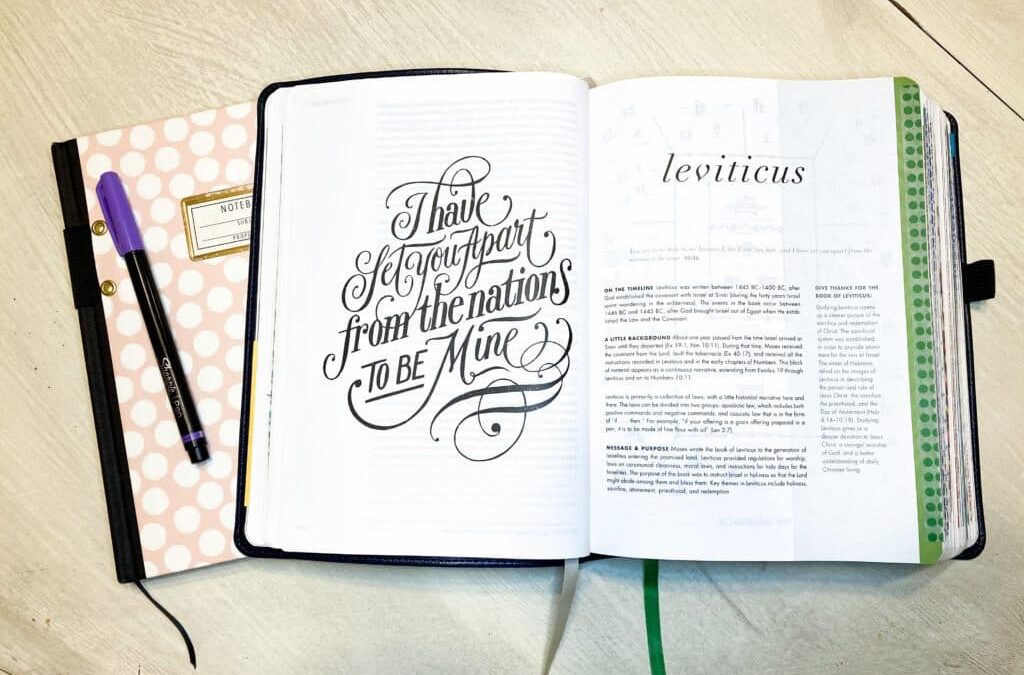
The goal was for God’s people to look different than other nations. God wanted the surrounding people to notice. Israel didn’t have a pharaoh or a king. Their ruler was God. As a result, they did things differently. God’s people are always supposed to look different than the world because we are set apart.
Note Repetition
The last thing I will mention, though I know this list is not exhaustive, is the most obvious. If God says something once, it is important. If God says the something multiple times, you need to pay attention. When you start to notice a phrase or sentence that is repeated multiple times, I recommend you take note by picking a highlighter color and marking that phrase in that color every time you come across it. (If you are opposed to writing in your Bible, you could print out a copy of the book and mark it up instead or track the instances of the repeated phrase in a journal.) This will give you a visual of the repeated phrases and help you understand why they are there.
An example from my reading includes the repeated phrase “I am the LORD” and “I am the LORD your God.” This phrase appears after every command given in chapter 19. It reminds me of a parent giving instructions to her child and ending each one with “I am your mother” as that is the only explanation needed to compel the child to obey.
I pray these tips will alleviate your fear of the book of Leviticus and help you come away from the book with a renewed sense of awe as you discover more about God. Spending time in the Word should never be approached as a punishment or requirement but should instead be approached with excitement and anticipation. These tips helped me look forward to reading Leviticus and brought me a deeper understanding of its importance.
If you apply these tips to your reading of the book of Leviticus, I would love to know how it goes for you!
My friend Natalie Eskew has graciously shared her story. It is a story of rebellion, forgiveness, and restoration after her abortion. God has allowed her to use her story not only to embrace and encourage others who have traveled that path, but also to warn and admonish those who consider that same path today.
***************
I’m Breaking My Silence
I don’t usually talk about politics publicly, but the pro-life conversation is a personal one for me. I’m not just another person who says abortion is wrong. I KNOW it’s wrong. I speak from experience.
Almost 17 years ago, I got rid of “it”.
I believed ALL the lies.
It’s a clump of cells.
It will stop you from your dreams.
Natalie Eskew shares her story of redemption after abortion.
You can’t be a single mom.
This is MY choice.
You name it, in my fear, I believed the enemy’s lies.
And here’s the thing…
I knew it was wrong.
I knew “it” was a girl.
I saw her heartbeat.
All I ever wanted to be was a mom.
I did it anyway.
I knew it was murder.
I was so caught up in my mess, I did it anyway.
I knew it was wrong so much that I was convinced I was going to hell.
How could God forgive me?
I killed my child.
So, this is personal.
Here’s where I stand, all these years later.
I mourn… my ignorance, her life, our life together. But God is healing me and restoring me. I know that my daughter is waiting without judgement in heaven for me. She was/is real.
Her life matters.
I wonder what she would have been like.
I wonder at how amazing of a big sister she would be to my girls.
I mourn for her life.
Because that’s what it was. It was HER life. It wasn’t my choice to make. That’s not my call. I’m not God.
So, a few things:
God forgives. Yes, even this. He forgives and if you need to talk about your abortion, send me a message. I am here to listen and point you towards healing.
It takes a miracle to make a baby, which means that baby was intricately woven and planned by our Father. Scripture is clear. There is no such thing as unplanned.
There are resources out there for you. There are clinics that support women fully through pregnancy (I work with one and will direct you to their services if you are in need). There are organizations that ask no questions, just help you save your baby’s life and find a home for him/her.
Pro-life for me is being there when a woman finds out she’s pregnant and sharing the Gospel and with it, hope. It’s being there for single, struggling mothers. It’s fostering children. It’s all encompassing. It should be.
This bears repeating. Only God could forgive a sinner like me… and He does. He remembers our sins no more when we come to Him in repentance. There is enough grace for you. For all of us.
Emily Joy would have turned 16 this year. My life is less because she’s not in it.
Note: I’m not trying to create a comment war. I finally decided to speak because I’m seeing how God wants to use Emily’s life for good. If I can save one baby because I shared the story of my abortion, it’s Him working her life for good. If I can help a friend who had an abortion (they say 1/4 to 1/3 of us have) then I want to help her not hate herself as I have hated myself for decades. And for the one who thinks she’s past saving… that there’s no hope for her… well, friend, there’s Jesus and He will never reject you. He is your hope. His eyes are filled with compassion for you and His arms are open to hold you as you weep. He loves you. He died for you. Yes, even knowing what you would do, He said you were worth it. YOU are still loved. You are still His child. You are safe with Jesus.
***************
The story doesn’t end there. If you would like to read Natalie’s follow-up blog post, “There Is Healing,” you can read it here.
I remember when Natalie first told me her story almost two years ago. She was sitting on the floor of my hotel room. It was late, and we had been talking for several hours. I could tell she wasn’t sure she could trust me with her story, but she took the risk. She knew God had plans for her story, and she and God had wrestled through the sin together. It has been an honor to watch as God has brought her to the place of sharing her story publicly, knowing she can trust Him to bring beauty from ashes.
While I do not believe you have to experience something in order to address the topic, the message is incredibly powerful when it is shared by someone who has walked that road. I’m so grateful to Natalie for speaking out on behalf of those who have no voice.
Out of respect for my guest, I will not approve any disrespectful comments. While you are entitled to your opinion, you are not entitled to post on my page.
So many people are looking for ways to add a stream of income to their families. Now that many are working from home, network marketing has come to the forefront. But not all network marketing companies are created equal. Here are some things to consider BEFORE you sign on the dotted line. (If you’ve already signed up, it is still a good idea to know the answers to these questions.)
How quickly can you earn back your investment?
Most network marketing companies have a “kit” for you to buy when you begin your business. I’ve seen these kits range from $99 to upwards of $1500 depending on the amount inventory you carry. So how quickly can you earn that back and start making a profit?
Things to consider include:
Does the compensation plan require you to structure your organization a certain way to make money?
Is the compensation plan clear, and is it easy to build your business and turn a profit?
Does the company require you to make a personal minimum purchase each month?
Do you make a commission on sales of product and on building a team (both, not just one)?
Are you required to carry inventory?
Does the company have bonuses and incentives when you begin your business to help you earn back your investment sooner? (My company calls it “Smart Start.”)
Are the products consumable?
When I sold purses, there came a point when my best customers had enough purses. It was not a consumable product. Although this isn’t a deal-breaker, it does mean you will need to continue to get new customers, and your warm market will dry up quickly. So it’s best to sell products that will runout. And they need to run out rather quickly. Let me use makeup as an example: Mascara is consumable. It runs out quickly enough for me to reorder. Blush, on the other hand, seems to run out long after my favorite color has been discontinued.
Another thing to consider when it comes to consumable products is the reorder process. Do the customers set up some type of automatic reorder so that the products arrive on their doorsteps with little to no effort on their part? If not, you will need to follow up with customers more frequently so they don’t forget to reorder before they run out of product.
Do the customers already use something similar?
This is another consideration that is not a deal-breaker but affects how you market the products. If you are asking your customers to change their lifestyle in order to use your product—for example, a fitness product—you will need to offer repeated encouragement. If you are asking your customer to use a product that is not intuitive—for example, essential oils—you will need to educate her on the product. Depending on how different or new the product is for your customer, you may be spending a lot of time offering support.
Is the business online, in person, or both?
There are pros and cons to all of these options, so you will need to know how each one affects you. If the business is strictly online, you will need to educate yourself on marketing online using social media, messaging apps, and video software. The benefits to an online business include working from home instead of hosting parties or manning booths. It also cuts down on the amount of inventory or demo products you need.
If the business is in person, you get to be around people; they get to see, touch, and smell the products; and, if you carry inventory, they don’t have to wait for shipping. The downside is traveling with your products, set up and breakdown time, and the inevitable party where no one purchases anything. You may also need to deliver or ship products after the parties if your company doesn’t ship directly to the customer.
The best of both worlds is when you can work the business online and/or in person. You can choose which you prefer and play to your strengths and your season of life. So before you decide to join a company, find out what your options are.
Could you surpass your up-line?
One of the biggest objections I hear about network marketing is the fear of a pyramid scheme. One easy way to know that you are not signing up for a pyramid scheme is to see if you can surpass your up-line or sponsor in income and/or rank.
While we are on this topic, I recommend that you look up the term “pyramid scheme” to set your mind at ease. A pyramid scheme is illegal, so if you have friends accusing you of joining one, you might gently recommend they educate themselves before throwing around the accusation.
Are your goals in line?
I have learned from experience that my business goes much better when my goals are in line with the company, my team, and the products. Do some research into the company and find out what is important to the founders/CEO. Why did they choose network marketing instead of traditional retail sales?
It is important to be part of a team that helps you grow your business in a way that feels good to you. I’ve been part of teams that used sleazy sales tactics, and I’ve been part of teams that taught healthy sales philosophies. It made a huge difference when I was promoting my business!
Do you believe in the products? It is very difficult to sell products you don’t believe in or you don’t personally use. If you can’t use the products, you probably shouldn’t be selling them.
I recently published a post about how to read the book of Genesis, so you might be wondering what makes Exodus different from Genesis. While it is true that both books were written by Moses under the inspiration of the Holy Spirit, and it is also true that both books are historical narrative, there is one major difference between the books: Moses was an eye witness to everything in the book of Exodus except for chapter 1 (the events leading up to his birth) and part of chapter 2 (his birth).
By verse 11 in chapter 2, Moses is a grown man, so everything else that happens in the following chapters is told to us from the perspective of experience.
Moses Shares His Experience in Exodus
Moses gave us a first-hand account of committing murder.
He experienced the burning bush that was not consumed.
He heard the voice of God telling him to go back to Egypt.
Moses argued with God about his qualifications.
He witnessed his staff turning into a snake and picked the snake up by the tail.
It was his hand that turned leprous and then was healed.
Moses stood in the throne room of Pharaoh and threatened him with the plagues.
He faced the anger of the Israelites who blamed him for their extra work.
Moses heard the great cry in Egypt when the first-born children died.
He was the vessel God used to part the Red Sea.
He was the one who struck the rock, providing water for the Israelites.
Moses walked up Mt. Sinai and communed with God.
It was Moses who received the Ten Commandments from God Himself.
He heard God’s promise of a land for the Israelites.
He received all of God’s instructions for how His people should live and worship.
Moses pled with God on behalf of the idolatrous Israelites.
He got to see the remnants of God’s glory.
It was his face that shone after spending time with God.
Moses led the Israelites in making everything to God’s specifications.
The fact that Moses was an eye-witness to these things doesn’t affect the credibility of the words (he was, after all, writing what the Holy Spirit told him to write), but it does affect the style of the writing. While Genesis may seem to jump around and miss details, Exodus is told in a more cohesive way. It is easy to follow along with the Israelites as Moses shares the details.
It is incredible to think that Moses experienced the things he wrote down. I often think experiencing just one of the things on that list first hand would be life-changing, and he got to experience all of them. But that is not the point of the book of Exodus.
Exodus Is about God
Even though Moses is giving us a first-hand account, the book of Exodus is not about Moses. It isn’t about the Israelites or the exodus, either. The book of Exodus is about God.
God saved Moses from the Nile river and Pharaoh’s wrath.
God showed up in the burning bush that was not consumed
God gave Moses instructions and encouragement as He called Moses to be the means by which He freed His people from captivity.
God rebuked Moses for questioning His plan.
God made the staff turn into a snake and back into a staff, and He made Moses’ hand leprous only to heal him.
God used the plagues to demonstrate His power above the gods of the Egyptians.
God was patient with Pharaoh, giving him chance after to chance to obey.
God showed his favor to the Israelites by confining the plagues to the Egyptians.
God demonstrated his mercy toward the Israelites, who by faith obeyed His instructions for the passover.
God followed through on His threats to Pharaoh when he refused to submit.
God showed up as a pillar of cloud and fire to guide and protect the Israelites.
God stopped the waters of the Red Sea, allowing the Israelites to pass on dry ground.
God caused the waters to cover and drown the hosts of the Egyptian army.
God turned bitter water into sweet water and brought water from a rock.
God provided food for the Israelites while they wandered in the wilderness.
God met Moses on Mt. Sinai and gave him the Ten Commandments.
God showed mercy to the Israelites when they worshipped the golden calf in sending a plague rather than annihilating them all.
God protected Moses as He passed by him.
God not only gave Moses detailed instructions, but He also empowered workers with supernatural talents to accomplish the tasks.
If you had printed out this post, I would instruct you to draw a big X through the first list. While Moses’ experiences are awe-inspiring, do not let them distract from the goal of the book: to know God. It is important for us to see God’s full character, and the book of Exodus shows us many facets. He is loving, merciful, and gracious, but He is also holy, jealous, and just.
When Proverbs 1:7 tells us the fear of God is the beginning of wisdom, we should not down play or reject the term “fear.” Yes, God is our father and our friend, and we are co-heirs with Christ, but we should never forget that God is holy and requires holiness from us, as well.