Updated. This Bible study post was originally published on May 6, 2020.
What tools do you really need to study the Bible? Honestly, you really only need a Bible and the Holy Spirit. If you don’t have a Bible, you can’t study it, and if you don’t have the Holy Spirit, you won’t understand it.
But beyond that, there are a few essentials you need if you want to really dive into the passage. As we move through this series, I will add the tools you need for each step. I know you want to know them all now, but you may decide to only work through step 3, so you won’t need the tools for step 4.To begin, though, let’s talk about the basics.
Which Bible Translation Should You Use?
This is a very personal decision. Bible translations are not the same as Bible paraphrases. There is a continuum of Bibles ranging from word-for-word translations to thought-for-thought paraphrases. It isn’t an issue of which is better, but it is an issue of understanding what you are using.
A word-for-word translation attempts to get as close as possible to the original language. A thought-for-thought paraphrase interprets the original language and writes it in a way that might be more familiar to you. It is up to you to decide if you want a Bible that might require a little more work to understand versus one in which someone else tells you what the passage means.
Which Bible Type Should You Use?
Should you get a study Bible? Should you get a journaling Bible? Should you get a large-print Bible? It depends on the outcome you want and what works best for you.
Study Bibles have great notes and cross-references. They tend to be bigger and heavier, and they can also be a bit more expensive. Unless you like hardcopy Bibles, you might prefer to access a lot of the notes online.
If your goal is to write in your Bible and take extensive notes, you should choose a Bible that has wide margins or a lot of white space on the page. And if you are a little nervous about writing in your Bible, getting a journaling Bible specifically for this exercise might be just the ticket you need to give yourself permission to mark up the pages.
Since I know you will ask, I have an ESV Study Bible I use for the notes and the cross-references. I have an ESV Single Column Journaling Bible I purchased when I started this study method. I also reference several other Bibles including the Study Bible for Women HCSB version, the CSB She Reads Truth Bible, the KJV Scoffield Bible, and the Reina Valera Spanish translation (yes, I have accumulated quite the collection of Bibles over the past 40 years).
Should You Get a Fancy Journal?
No, don’t go buy a fancy notebook. One of the biggest roadblocks to diligent Bible study is being afraid to ruin a beautiful notebook with your scribblings. And you will scribble. The goal isn’t to write the next great Bible commentary, but to have a place to jot down your thoughts, prayers, reactions, and research. Start with a notebook in which you are not afraid to write.
Make sure you choose a paper notebook and not an app on your phone or a document on your computer. There is something that happens in the brain when you physically connect pen to paper. As you watch your hand write the words, they become part of you. Since the end result you desire is to grow closer to God by studying His Word, it makes sense that you make the words part of yourself.
Which Pen Is Best?
Do not put too much importance on the pen. I have used a cheap Bic pen, Sharpie pens, PaperMate Ink Joy pens, erasable pens, and they all have their pros and cons. For this first step, while you’re still taking notes, the pen doesn’t matter. When you get to step 6 where you will write in your Bible, we will revisit this question.
This series is designed so you can stop the overwhelm of Bible study. You can end the study of a passage at any step in this process. Always start with step 1, but go only as far as you want to go. If you would rather download the process in a FREE workbook, you can enter your information below, and it will be delivered directly to your email.
Updated. This Bible study post was originally published on May 1, 2020.
Are you tired of being told what the Bible means rather than being able to study it for yourself? Have you ever done a Bible study and felt like you were learning so much, but when the study ended, so did your growth? Do you feel like you can’t have spiritual conversations because you just don’t know enough? Are you afraid to witness because someone might ask you a question you can’t answer?
There are few things in this world more frustrating than the feeling of inadequacy when you think you should be confident. I grew up in a missionary’s home, attending church from the very first Sunday I had breath. I could answer all of the Sunday school questions, and I knew all of the Bible stories. I graduated from Bible college AND seminary. In spite of all of that, I felt unqualified to have spiritual conversations, and I didn’t know how to apply what I knew to real-life situations.
The truth is that growing up in a preacher’s home created some challenges for my personal walk because it was always easier to ask my dad than to search Scripture for myself. And this was my pattern even through adulthood. It wasn’t until my dad started showing symptoms of Alzheimer’s that I realized I needed to bulk up my own spiritual muscles. But where to start?
Pursuing Godliness through Bible Study
I like to compare the pursuit of godliness to a health journey. We know the only way to get healthy is through diet and exercise. In the same way, we know the only way to get healthy spiritually is through personal Bible study and prayer time.
If you’re like me, you have a cabinet full of shakes, pink drinks, supplements, and wraps to help the weight loss process along, but if you look at the fine print, they will all say “works best when paired with proper diet and exercise.” In much the same way, we buy books about the Bible, listen to sermons, subscribe to podcasts, and do big-name Bible studies to help our spiritual walk. All of these things are good, but they all work best when paired with personal Bible study and prayer.
Without personal Bible study, how do you know the book you are reading or the sermon you are listening to is teaching truth? We have to put in the effort to cut out the middle man. We have to learn to study Scripture and pull out the principles on our own.
“God looks down from heaven on the children of man to see if there are any who understand, who seek after God” (Psalm 14:2 & 53:2)
Stop depending on others to tell you what the Bible means and learn to study it for yourself.
God wants you to look for Him.
God wants you to seek Him.
God wants you to find Him.
“You will seek me and find me, when you seek me with all your heart” (Jeremiah 29:13)
Here’s the good news: Godliness is learned! It isn’t reserved for an elite few. Godliness is available to all of us.
“His divine power has granted to us all things that pertain to life and godliness, through the knowledge of him who called us to his own glory and excellence” (2 Peter 1:3)
The way we grow in godliness is by growing in our knowledge of Him. And you have all you need to do that in the pages of your Bible. Ok, so what’s the first step?
There are many plans out there that you can try, but if you don’t want to look any further, you can find your guide here. I took the Bible study tools that worked and created a Bible study process. I have created a blog series that spells out the unique process that always begins at step 1 but only goes as far as your current season of life allows. If you would rather download the process in a FREE workbook, you can enter your information below, and it will be delivered directly to your email.
I remember the moment very clearly. I was driving home from our new business feeling so defeated. Our tax guy had just given us the bad news: We would have to pay $20K in taxes. It might as well have been $1M!
As tears streamed down my face, I recounted all of my failures since we started the business. I had left a career I enjoyed to become a stay-at-home mom and help my husband get the shop off the ground. I discovered I wasn’t a natural homemaker, I didn’t enjoy cooking (and my family didn’t enjoy it, either), I wasn’t gifted at nurturing (I’m more of a “rub some dirt in it” kind of mom), and now I had failed at the business finances. All of my dreams for this transition seemed to be turning to ashes. I remember saying out loud, “Lord, I’m done. I can’t do this on my own. I need help!”
Because I had grown up in a pastor’s home, I knew the Bible. I could win the Bible Trivia games and the sword drills. But when I faced crises in my life, I turned to my dad. My dad was a very godly man, and he gave me great advice, but I should’ve been turning to God’s Word. I think this is a hazard many PKs face. This time, I didn’t have that choice. My dad had started showing signs of Alzheimer’s and could no longer fill that role in my life.
I couldn’t expect God to speak to me if I wasn’t spending time in His Word and speaking to Him through prayer. So I began to read my Bible. I got involved in Bible-reading plans, Bible studies, and conferences. And I found that, as cliché as it might sound, the more time I spent in God’s Word, the more time I wanted to spend in God’s Word. As the Holy Spirit revealed things to me in the Scriptures that I had never really grasped, I began to fall in love with my Bible.
Just to be clear, not every time I sat down to read did I have a hallelujah moment—sometimes those genealogies are hard to get through—but as the knowledge compounded, and as I sought the wisdom of the Holy Spirit, that knowledge shifted to wisdom and discernment. I started to recognize false teachings. I became sensitive to the struggles of those around me. And I became more and more content in my life.
My circumstances didn’t change: I still was not a natural homemaker, my family still didn’t like my cooking, and we hired a new accountant in our business to handle the finances. But I had changed. God’s Word changed me! Hebrews 4:12 says, “For the word of God is living and active, sharper than any two-edged sword, piercing to the division of soul and of spirit, of joints and of marrow, and discerning the thoughts and intentions of the heart.” Because the Bible is “living and active,” we can trust that it can change us and grow us.
Since those days, I have gone beyond using other people’s studies to studying God’s Word for myself. I took bits and pieces from everything I had learned throughout the years, and developed my own Bible study process. It takes time, and it takes effort, but the reward is so worth it. Psalm 14:2 and 52:3 say, “The LORD looks down from heaven on the children of man, to see if there are any who understand, who seek after God.” I want to be seeking after Him when He looks down from heaven!
Because I have fallen in love with the Word, I want to share it with others. I have created a free workbook that outlines my study process. It is a unique process in that you always start at step 1, but you only go as far as you want to go or as your current season of life allows. You can download your copy of the workbook here. And I can’t wait to see what God does in your life through His Word!
A couple of years ago, I recognized that if I lost access to the Bible, I didn’t have enough of it stored up in my memory to hold on to it in tough times. So I started the spiritual discipline of memorizing Scripture. Mind you, at that point I was 40+ years old. I had a real fear that my brain couldn’t do it. I was already struggling to remember people’s names and connecting them to a time and place in my life. I had also watched my dad succumb to early-onset Alzheimer’s. Could I really memorize Scripture and retain it? It helped to have some tips and tricks, so I want to share those with you.
Why Memorize Scripture
But let’s take a step back and talk about why it is important to memorize Scripture. Beyond the threat of losing access to Scripture on our shelves and on our phones, the Bible tells us to hide God’s Word in our hearts. We are given this command for several reasons.
As a mom, one of the most important reasons for me to memorize Scripture is detailed in Deuteronomy 6:6-7, which tells us to hide His words in our hearts and “teach them diligently to [our] children.” I can’t teach my kids something I haven’t learned.
Of course, the spiritual discipline of memorizing Scripture isn’t limited to parents. Every believer is instructed to meditate on God’s Word day and night. Often, when we read Scripture, we walk away from it and don’t think about it again, but when we memorize Scripture, we are rehearsing it, repeating it, meditating on it throughout the day. And as we practice and repeat a passage, it takes root in our hearts and our understanding of the passage grows.
Ultimately, the goal is to be shaped by Scripture—to develop a biblical worldview, the lens through which we see the world. Memorizing Scripture allows the Word of God to inform our thoughts, which shape our feelings and actions. Living life with a biblical worldview is for our good and is how God intended us to live.
Don’t Believe the Lies
While there are many excuses NOT to memorize Scripture, what you have to decide is how important it is to you. Are you willing to do the work, to practice, to train, and to strive for godliness? We know we can memorize information that is important to us—if I asked you to tell me your social security number, I have no doubt it would be top of mind, or if your favorite song comes on the radio, it isn’t hard to sing along. Don’t believe the lie from the enemy that you are not capable of committing Scripture to memory.
So let’s get into the tips:
How to Memorize Scripture
First, decide which translation you want to use (to see a discussion on the spectrum of translations, see this blog post). Are you more familiar with one translation? Is there one that is easier for you to understand? I’m personally partial to the translations closer to the word-for-word end of the spectrum. I would encourage you NOT to choose a paraphrase simply because paraphrases are someone’s interpretation of someone else’s interpretation so they are further away from the original than a translation will be.
There are many ways to memorize, and they will appeal to you depending on your learning style. If you are a visual learner, you might want it typed up and laminated so you can take it with you. If you are an auditory learner, you may want to record it in a voice memo to play back or put it to music. If you are a kinesthetic learner, you might enjoy putting motions to the passage. Whichever type of learner you are, memorization requires repetition.
The system I use to commit Scripture to memory is below. Feel free to modify it as best suits your learning style.
For the first verse in the passage:
Step 1: Read the verse aloud 10 times.
Step 2: Recite the verse 10 times.
Step 3: Write the verse from memory.
When you get to the second and future verses in the passage:
Step 1: Recite the previous verse 10 times.
Step 2: Read the new verse aloud 10 times.
Step 3: Recite the new verse 10 times.
Step 4: Write the new verse from memory.
Step 5: Recite the passage from the beginning.
I like to use the FLOW method to remember the verse throughout the day. FLOW stands for First Letter Of the Word. You can write the first letter of each word in the verse on your hand, set them as the wallpaper on your phone, write them in your planner, put them on a post-it note and put it where you will see it frequently, etc. This reminds me to rehearse the verse as I go about that day’s activities.
I’m always open to new ideas, so if you have another method that has worked well for you, please share it!
If you would like to learn more about how to study the Bible, I invite you to download my FREE Bible study workbook, 6 Steps to Study the Bible on Your Own, at the button below.
If you would like to join a group of like-minded women who are pursuing godliness together, check out the Bible Study Academy by clicking the button below.
I was not catechized as a kid. I don’t know if it is because catechism was a foreign concept to my parents, or if it was because I grew up in a Roman Catholic country, where catholicism is engrained in the culture, and there is a lot of repetition with very little belief. For whatever reason, this is something I wasn’t exposed to as a kid. Now that my own kids are teenagers, I have only recently discovered catechisms.
According to Meriam-Webster, a catechism is “a summary of religious doctrine often in the form of questions and answers.” Different religions have their own catechisms. Two catechisms I’ve encountered are the Heidelberg catechism and the Westminster catechism. They are a series of questions about the different aspects of theology, along with the answers supported by Scripture.
The idea is the teacher asks a question, and the students respond in unison with a memorized answer. For example, question 1 of the Westminster Shorter Catechism is “What is the chief end of man?” And the answer is “Man’s chief end is to glorify God, and to enjoy him forever.” The Scriptures that supports this answer include 1 Corinthians 10:31 and Psalm 73:25-26.
For those who grew up in a strict or legalistic environment that required catechism, it can be difficult to separate catechism from negative memories, but most adults I’ve asked who were catechized as children are grateful. They have had the memorized answers bouncing around in their memories as the world seems to have spun out of control.
But let me encourage you. God’s timing is perfect. So you are not too old to be catechized. And, truth be told, you may understand and appreciate it more as an adult. It is never too late to learn the catechism questions and answers and to dive into the Scripture that teaches the principles.
Are you ready to learn about things like justification, the commandments, and prayer? If so, join me in learning the Westminster Shorter Catechism. I have linked a couple of resources, and I will be creating posts of the different questions each week on my Instagram account.
Do your eyes glaze over when you encounter a genealogy in your Bible reading? Do you gloss over them or skip them altogether? Here is a short list of things biblical genealogies teach us and how we can approach them.
Genealogies are sprinkled throughout the Bible. Some books contain big portions of these lists of names and all of their descendants. If you’re like me, you tend to get hung up on how to pronounce some of the more difficult names. It is easy to get discouraged with Bible reading when you don’t understand why the genealogies are there.
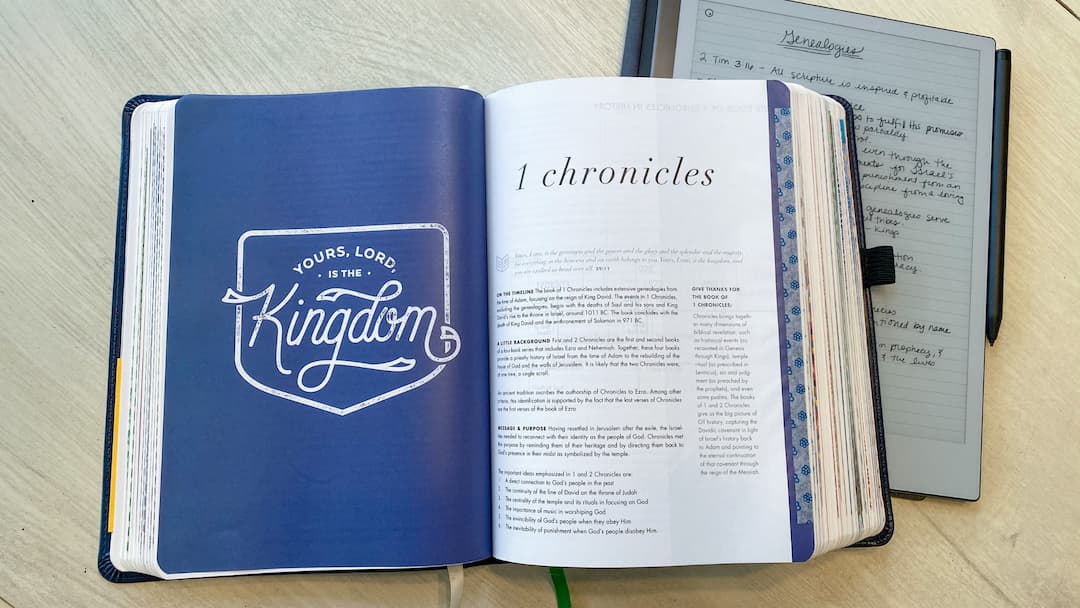
As I’ve been reading through the Bible, I’ve encountered genealogies throughout, but when I landed in 1 Chronicles, and I saw chapter after chapter of lists, I decided to do some research. I wanted to understand why God included these lists for us in His Word.
Let me encourage you and challenge you not to gloss over genealogies as you come across them in Scripture. 2 Timothy 3:16 says,
“All Scripture is breathed out by God and profitable for teaching, for reproof, for correction, and for training in righteousness.”
(ESV)
Genealogies are not an exception to this verse, so they are profitable for us to read and study. This begs the question: What do genealogies teach us?
Genealogies Teach Us There Is Only One Race
One of the most important things genealogies teach us is that there is only one race—the human race. Especially given the current climate in our society, it is important to recognize that we can all trace our lineage back to Noah, and from Noah back to Adam. God was careful to show us in Scripture that He did not create different races. In fact, in reading the history of the Tower of Babel, we are shown that ethnicities were originally divided along language lines, not skin colors.
Genealogies Demonstrate God’s Faithfulness To Fulfill His Promises
In Genesis, God promised Abraham that He would make Abraham a great nation. God told him he would have descendants that would be like the grains of sand or the stars in the sky. When God gave us the book of Numbers and the genealogies thereafter, He showed us that He kept this promise.
Even through the captivities Israel survived (these were consequences for turning away from God), God’s faithfulness remained. When the Hebrews came back to the promised land, genealogies served to give the land back to the rightful tribes. God proved that He cares about restoration. Because the Israelites had genealogies, they could prove their identity as Jews and, for some, that meant proving their calling as Levites or priests.
God Doesn’t Show Favoritism, and He Does the Choosing
If you take some time to read the genealogies carefully, you’ll realize there are names included that seem not to fit. In the midst of the lists of names, we find names of women and names of Gentiles (non-Jews). While God was fulfilling His promise to Abraham to make him a great nation, He included unlikely people and grafted them into the Israelite family. An Israelite would never have chosen Ruth, a Moabite, to be the great grandmother of King David, yet God chose her to be in the lineage of the prophesied Messiah.
God Cares about Individuals
Take a moment to ponder that God lists his people by name. While the names are strange and difficult for us, He knows each one of them. He knows who they are and who their children are. Isaiah 43:1 says,
“But now thus says the Lord, he who created you, O Jacob, he who formed you, O Israel: ‘Fear not, for I have redeemed you; I have called you by name, you are mine.'”
(ESV)
And Psalm 139:16 tells us,
“Your eyes saw my unformed substance; in your book were written, every one of them, the days that were formed for me, when as yet there was none of them.”
(ESV)
God cares about us individually, He knows what is going on with us, and He knows what will happen in our future.
Genealogies Confirm Prophecy
Several genealogies in Scripture are there to prove that Jesus fulfills the prophecy of the Messiah. They show that Jesus was a descendant of David, and that He fulfills the words of Isaiah and other prophets in the Old Testament. Genealogies used in the Gospels are there to show who Christ is with the focus that specific Gospel has. He is the prophesied King, He is the Son of God.
Importance of Family
One important lesson we can learn from genealogies is the value Scripture places on the family. We are instructed to talk about God’s Word with our children:
“You shall teach them diligently to your children, and shall talk of them when you sit in your house, and when you walk by the way, and when you lie down, and when you rise.”
Deuteronomy 6:7 (ESV).
And we are promised blessings when we do—and not just any blessing, but blessings to a thousand generations:
“Know therefore that the Lord your God is God, the faithful God who keeps covenant and steadfast love with those who love him and keep his commandments, to a thousand generations.”
Deuteronomy 7:9 (ESV)
God knows you and your children by name. He cares about you and them. He doesn’t show favoritism based on your past or your circumstances. He is in control of your present and future. And you can trust Him. That is what genealogies teach.
This list is not exhaustive, but it’s a great place to start as you approach genealogies in Scripture. And they become even more interesting when you research meanings of names and the lessons taught through individual lives.