How would you define an idol? Having grown up in church, I know all of the stories about the Israelites and their idols: the golden calf, the foreign gods, even Dagon, the idol that bowed down to the Ark of the Covenant (1 Samuel 5). When we think of idols in this context, we would claim not to worship idols.
But idols don’t have to be crafted with our hands. An idol is anything that takes your attention off of God, anything that keeps you from your time with God. In this context, sleep can be an idol, TV can be an idol, and, dare I say it, food can be an idol.
Did you realize your “quiet time” can become an idol, too? It seems contradictory because your “quiet time,” your time in the Word, isn’t taking your focus off of God, right?
Oh, but it can!
It’s all too easy to spend time in the Word just so you can check it off your to-do list, post a pretty Instagram picture with your coffee and your colorful pens, or hit a goal you’ve set for yourself. The motive behind your devotional time can be pulling your focus off of God.
When I allow perfectionism to keep me from the Word because I think I have to have the prettiest space or the right Bible or the perfect pen or the best mug for my coffee, I am making my quiet time an idol.
When the reason for my time in the Word is to reach a goal or check it off a reading plan, I’ve lost focus of the purpose.
When I use my “quiet time” as an excuse not to face my responsibilities, or I wear it as a badge of honor so others can see how spiritual I am, my “quiet time” has become an idol.
Spending time in the Word should be a time of worship when we focus on knowing God more intimately.
So how do I avoid creating an idol out of my devotional time?
Realize that God’s expectation is that you will come to Him as you are. You don’t have to get your ducks in a row, clean up your act, or get your house in order to spend time with Him. Think about it this way: what are your expectations of your kids before they come to you? Do they need to clean up? Do they need to look or act a certain way? Would you reject them if they didn’t? Of course not! If my son wants a hug from me as he’s walking off the baseball field after a grueling double-header in the heat of summer, he gets that hug! Why then do we think God has expectations of us before we come to Him?
If you realize you are distracted and having a hard time focusing on what you’re reading, stop. Figure out what the problem is and fix it, or come back to your reading later in the day when you can be more focused. Minimize distractions as best you can, but be flexible and have grace. While you should have a plan, it shouldn’t be too rigid. You are developing a relationship, not simply trying to be more productive with your time.
Litmus Test
A great question to ask yourself is if you couldn’t tell anyone about your devotional time, would you still do it? I’m not encouraging you to keep your study to yourself—we need community and accountability—but if all of that was stripped away, would you still spend time with Him? If you know your answer to this question is “yes,” then your devotional time is really about your relationship with the Lord.
If your answer right now would be “no,” don’t quit. Giving up won’t solve the problem. Refocus. Repent, ask forgiveness, and realign.
If you need help with your time in the Word and want to learn to study it for yourself so you don’t have to depend on someone else to tell you what it means, download my free 6 Steps to Study the Bible on Your Own Workbook.
[activecampaign form=13]
If you would like to read more blog posts like this one, click here.
If you’re like me, you have been listening and searching for good godly resources to learn how to navigate our current cultural climate. In that quest, I repeatedly came across Latasha Morrison’s book, Be the Bridge: Pursuing God’s Heart for Racial Reconciliation. This book was promoted and recommended by Christian leaders I trust and respect. And the title spoke to the very issue I was seeking: God’s perspective.
I approached the book with excitement and anticipation. Having grown up in another country and culture where my light-haired, light-eyed, light-skinned family stood out (we quite literally stood out; I remember being accused by one of my friends of slouching so I wouldn’t be so much taller than everyone else), I was anxious to understand how and when we had gone so wrong. How was it that we could all agree that Mr. George Floyd’s death was unequivocally wrong, yet that very event divided our country so dramatically? I was hoping to find an answer, a solution, a biblical perspective.
I had my hot tea in hand and was snuggled in my bed with my pillows propped up under me. I was in it! No interruptions, no notifications, no distractions. But as I started reading Be the Bridge, an unrest settled over me. Something wasn’t right. I began to realize this wasn’t a biblically-based, Christian book but was instead a culturally-driven book that contains Scripture within its pages.
I am a Christian first
As a believer who has gone on a journey of pursuing godliness, something has become very clear to me: When I became a Christian, my identity in Christ took precedence over every other identity I have.
Before I am a mom, I am a Christ-follower.
Before I am a wife, I am a Christ-follower.
Before I am a woman, I am a Christ-follower.
Before I am an American, I am a Christ-follower. And so on.
When I approach life from the perspective of being a daughter of God first, I can align my thoughts, words, and actions with Scripture and watch the pieces fall into place. But if I get my identity out of order, the filter through which I interpret life shifts. When my identity in Christ takes a back seat to my identity in anything else, I argue my positions from a worldly perspective and try to make Scripture fit that position. That is what I recognized in this book.
Morrison writes Be the Bridge as a black woman who happens to be a Christian, not as a Christian who happens to be a black woman.
Why is this a problem?
While there may be nothing wrong with following Morrison’s formula for racial reconciliation as laid out in Be the Bridge (though I would argue not all of the steps are biblical), the solution she presents is a secular solution that is firmly rooted in the current culture. Because the solution is not biblical, she must take Scripture out of context to make it fit the argument.
Some examples of this:
She quotes John 8:32 and other references about truth to support her argument that we must learn our nation’s “true” history. While I am in favor of hearing the untold stories of all ethnicities in our history, the Truth Scripture describes is not in the historical accuracy of America’s past but in the Gospel. The Truth that sets us free is the truth of Christ’s death on the cross to atone for our sin and His resurrection from the grave as He defeated death.
She cites the stories of Ezra and Daniel as they repented before the Lord on behalf of the entire nation of Israel during a time of judgment in Israel’s history to argue that white people should repent for the atrocities committed against minorities in American history. Ezra and Daniel lived during the time of a priesthood system established by God that was abolished when Christ became the final sacrifice. Now we have a personal and individual relationship with God, and while we can feel sorrow for the sins of another, we can’t repent on his behalf. And they repented before God, not before man, but Morrison indicates that the reader needs to demonstrate remorse and repentance before men, though it is unclear to which person(s) one would go to seek forgiveness.
Finally, she uses the Great Commission given in Matthew 28:18-20 to argue that, in an effort to accomplish God’s plan of racial reconciliation, we must reproduce her bridge-building groups. So she uses the Great Commission as an argument to go and make disciples, not for the cause of Christ, but for the cause of racial reconciliation.
These are just a few of the examples where Scripture is taken out of context to support a cultural expectation.
While I disagree with the overall premise of the book, I am glad I read it. It has given me a very clear picture of how cultural Marxism is infiltrating our churches. It is subtle because, on the surface, it looks like a biblical solution. It looks like loving your neighbor. But cultural Marxism can never be joined to a biblical argument successfully because it is an opposing worldview. More on this in a future post.
In Conclusion
The conclusion I have reached after reading this book, listening to so many contradictory voices, and researching the topic is that the solution will only come when we are changed from the inside out. Following someone’s prescribed steps without the transformative power of salvation and the clarity of Scripture will never satisfy. True change will only come as we grow closer to the One in Whose image we are created.
To learn more about how to study the Bible on your own so you can become a discerning reader, check out my FREE Bible study workbook: 6 Steps to Study the Bible on Your Own. You can download it here.
[activecampaign form=13]
Disclaimer: This is a review of the content of this book specifically. It is not a commentary on the author or anything else the author has written, said, or done.
“You were tailor-made, carefully crafted, minutely detailed for a selected divine agenda.”
There are some incredible historical accounts written on the pages of Scripture. And many times, it is easy for us to romanticize the lives of the people involved in those stories. The reality is that we generally simply get a snapshot of one event that takes place, and we don’t necessarily get a view of their lives day in and day out.
Nehemiah’s Vision
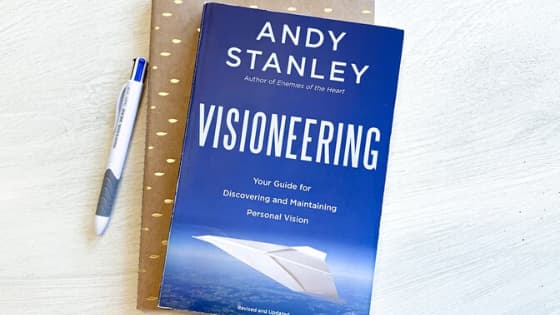
The book of Nehemiah shows us the time in Nehemiah’s life when God gave him a vision for Jerusalem and the Israelites. We get to see it from the beginning until the vision becomes a reality. In his book, Visioneering, Andy Stanley uses the book of Nehemiah to show us step-by-step how to live out the vision God places on our hearts.
“Visioneering is the course one follows to make dreams a reality.”
We’re reminded that our vision is not just ours, but it has been given to us by God, and it is only a small piece of the puzzle that is God’s overall plan.
“Your vision is simply an extension of his vision.”
Set Backs for Your Vision
Stanley reminds us that there will be critics just as Nehemiah had critics. He encourages us through the distractions, just as Nehemiah had to avoid the distractions. He brings to bear the importance of having moral authority, character, and integrity. Nehemiah’s enemies weren’t victorious because he lived what he preached.
“Nehemiah’s vision wasn’t so much about rebuilding a wall as it was about reestablishing a context for God to demonstrate his power and fulfill his promises to the nations.”
If God has given you a vision, and you can’t imagine how it will come to be, remember that, “You’re not responsible for figuring out how to pull off God’s vision for your life. You are responsible to do what you know to do, what you can do. And then you must wait.”
Success of Your Vision
Finally, be careful how you define success. Stanley points out that if we measure success based on completed visions, we are setting ourselves up for disappointment. We need to reframe our definition of success.
“Success is remaining faithful to the process God has laid out for you.”
In God’s eyes, you are just as successful the moment you step out in faith to accomplish the vision as you are when that vision comes to be. Success is obedience regardless of the outcome.
Disclaimer: This is a review of the content of this book specifically. It is not a commentary on the author or anything else the author has written, said, or done.
Is your confidence rooted in your appearance? Do you find that your mood is better when you’re having a “good hair day”? Or maybe your worst days are when you step on the scale? My beautiful friend and colleague, Tammy Hickey, describes how we can flip the script and put our focus where it belongs. Here are her words:
My heart sank as I walked by the mirror. Up until that moment, I had forgotten I didn’t have any hair.I had been going about my day, doing what I do.Working.Creating. Editing. Sharing ideas.Knocking things off my To Do List.I felt good physically and had good energy.It was a GOOD day!Then …. I had my moment in the mirror.I immediately lost my joy.The fact that I had cancer came rushhhhhing back into my thoughts and my being.BLECH.
Have you ever been there, friend?
Have you gone about your day, feeling good and feeling joyful, and then you walk by the mirror and BAM – your energy and joy is immediately sucked out of your body?
I know.ME TOO.Even without cancer.
We are so critical and so OVERLY aware of our bodies.We place SO much value on what is happening on the outside that it can be all consuming.It immediately dismisses or erases every single thing we have done, who we have served, who we ARE.Don’t you hate that?When our whole disposition goes down the tubes because we’ve don’t like our thighs, or we’ve put on a little weight, or our jeans don’t fit, or we feel like we look like a freak without hair.You get the picture.
Why do we do that to ourselves, friend?WHAT IS OUR DEAL?
Here is what I know for sure, friend.We have been led astray.The pressures of this world to be and look a certain way as crept into our BEING.Maybe it was from a comment someone made to you back in 9th grade about ‘looking like a pig’ or maybe it was the way the other girls looked at you when you changed for gym class.Or maybe it was the nickname of thunder thighs that your Dad (love you Dad!) gave you.Perhaps it’s the way you ‘think’ your husband avoids caressing or holding onto your ‘fluffy’ areas when you are intimate or the look he gives you when you grab a bowl of ice cream before bed.
Then add in the images we see all over social media, TV and print ads that over glamorizes what healthy and beautiful looks like.The way our feeds have been overcome with botox injections, fake bushy eyebrows (what the heck is with that trend?) or have you seen the ads for the exercise equipment where the girl is running full speed UP HILL with perfect posture, a smile on her face and then dances when it’s done????COME ON!!Don’t even get me started with this year’s Super Bowl Halftime Show.
We take all of these images of what society tells us beautiful looks like and take that on as an expectation – a bar set that we can NEVER reach!Because of that expectation, we look for evidence constantly of where we don’t measure up.How we feel like our husbands are not attracted to us anymore because of how we look and we immediately create scenarios of how we see that to be true.The hand placement.The look he gives.THEN WE GET MAD AT HIM.Lord, have mercy.
“Charm is deceptive, and beauty is fleeting; but a woman who fears the Lord is to be praised.” (Proverbs 31:30)
Here is what I’m learning, friend – NONE OF THOSE THINGS ARE REAL.
The image of perfect body?NOT REAL (as much as I commend J Lo – this is NOT the standard)
A perfectly shaped brow?NOT REAL
Running Uphill is easy and enjoyable?DEFINITELY NOT REAL
We, as women, are made perfectly in HIS image.He created us to be living, breathing beings in a body that is intended to help us fulfill the purpose He gave us.The body itself is not to be praised.What is to be praised is the real reason we are here – to fulfill His purpose on our life and to glorify HIM.To radiate His love from the inside out.
End of story.
Let’s stop getting it wrong, shall we?
Not to say that having a healthy body is not critical – it is!Our body needs to be working WITH us and not against us, so it’s important that we take care of it.Nurture it.Treat it like the beautiful vessel that it is to help us fulfill our purpose.
But our bodies are not the point.
Perfect eyebrows are not the point.
Thin thighs and six pack abs are not the point.
Being able to run on mission for the glory of God is the point!
Friend – when we put Jesus first in our lives, we learn how to slowly turn the tide of what we view important and critical.I won’t lie and say that I don’t struggle with the idea of being PRETTY by the world’s standards.I still cringe at the size of my thighs and struggle with my baldness. BUT I’m learning how to fill my heart with more truths about what true beauty is all about.
The condition of my heart.
The love I give to others.
The calling on my life that I’m fulfilling.
It is more important to me that the imprint I leave on this lifetime has more to do with the love of Jesus that radiates from my heart, then being another pretty face.
THAT to me is way more beautiful.Wouldn’t ya say?Who is IN with me?
Do you get that feeling in the pit of your stomach every time you see someone succeed? It might bejealousy, but more than likely it is related more to insecurity—that feeling that you should be further along in your own journey.
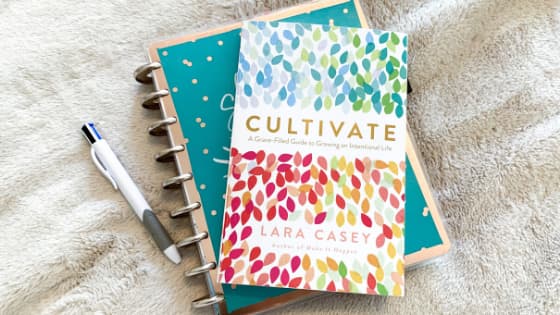
It seemed like everywhere I turned, I was being told to hustle harder, get there faster, and do more because that was the only way to succeed. But the harder I worked the less fulfilling everything felt, and I wasn’t making any progress. I knew I needed to stop the hustle, but I wasn’t sure how. Then I read Lara Casey’s book Cultivate: A Grace-Filled Guide to Growing an Intentional Life.
“I was tired of living in a state of lack—lack of time, lack of peace, lack of confidence, and lack of meaningful connections with people.”
In a world where we are pushed to be over-night successes (very unrealistic), Casey encourages us to cultivate our lives, taking it slowly, savoring the journey, and enjoying the moment. Instead of anticipating the next step, we should linger in our current season, soaking it up.
This doesn’t mean we do nothing, but it does mean we alter our perspectives and change our mindsets. We show up, we do the work, but we trust God for the results. And then we enjoy the journey as it unfolds.
Casey uses her personal story to walk the reader through the process of preparing the garden, digging in, and savoring the fruit. This is a process that takes time and requires patience—both of which are not promoted in our hustle-hard society. And yet they are what we really need to feel fulfilled in our day-to-day lives.
By stating the lies we’ve been told and confronting them with Truth, Casey demonstrates how fulfillment will come not from the worldly success we are told to chase, but from resting in the calling God has placed on our lives.
“Harvesting means noticing the fruit that God has grown in your life and doing something with it. But if you are rushed, or are constantly distracted by what isn’t growing, you’ll miss it.”
Honestly, this short blog post cannot do justice to this book. If you are looking for some direction for enjoying your life instead of constantly pushing for what is next, read this book. Because I read this book, my word of the year is Cultivate. I wanted the constant reminder so I wouldn’t fall back into my hustling ways.