by Kelli Garms | Apr 17, 2020 | Family, Women's Ministry
I was convicted when a friend reminded me that every time I say “yes” to one thing, I’m saying “no” to something else.
If I say “yes” to spending quality time with my family, spending time in the Word, or catching up with my friends in real life, I am saying “no” to other things that drain my time, energy, and focus. That is great news! But when I say “yes” to scrolling Facebook for an hour, binge-watching Netflix, or playing Candy Crush until my lives run out, I’m saying “no” to things that enrich my life and make me more productive. Yikes!
I was challenged to write down how I spend my time every day to see where my time is going. It was humbling. It makes it hard to complain about not having enough time in the day to do the things I know I should do when I have tracked my time and can see where I wasted it. It is also good accountability. I think twice about grabbing that remote if I know I’ll have to record “I watched an episode of Castle that I’ve seen at least 5 times before instead of writing my quota for the day.”
Working from home is very difficult. The distractions in our homes are endless. If there are no dishes to do, there is laundry to wash. If there is no laundry to wash (and when isn’t there), there is vacuuming to do. I will do chores I hate just to give me an excuse to procrastinate a little longer.
God has given each of us 24 hours in the day. James 4:14 reminds me that my life is a vapor. I need to use my time wisely to honor God, my family, and my ministry. This means spending time in God’s Word, nurturing my marriage, teaching my kids, serving my family, cultivating ministry, growing my reach, etc.
I doubt I will get to the end of my life and wish I had reached the next level of Candy Crush!
Have you done a time inventory lately?

by Kelli Garms | Apr 3, 2020 | Family, Spiritual Growth
You may or may not have noticed that earlier this week, I published a post to my feed about the Enneagram, and later that same day, I deleted it. I want to talk about why I felt convicted enough to do that.
Let me start by giving you a little bit of my background with the Enneagram so you can understand my point of view. The first time I heard of the Enneagram was in a business context. It was coming up repeatedly in conversations with my team in the network marketing business with which I am partnered. And it seemed that every business podcast I listened to or blog I read, whether Christian or secular, was talking about the Enneagram.
I was not introduced to the Enneagram as a spiritual tool until I got curious enough to Google “Is the Enneagram biblical?” At that point, I came across many well-respected Christians who were using it personally and in their ministries. Then a friend introduced me to my Enneagram mentor who approached it completely from a spiritual and biblical standpoint. When she explained it, it made sense to me, I understood it, and I could see the spiritual implications. I was hooked!
I have been studying the Enneagram for about a year. I have had so much fun with it! I have enjoyed what it says about me and why I do the things I do. I have paid closer attention to my marriage based on what it says about my husband’s personality. I have had serious conversations and fun conversations with my kids about topics the Enneagram has introduced. I can honestly say that I have learned a lot over the last year.
But let’s be clear about something: the Enneagram is made up! You can search your Bible from cover to cover, and you will not find a single mention of the Enneagram. There is some debate about the origins of the Enneagram, but whether it is an ancient tool or was devised in the 20th century, it is still a human invention. As such, it is fallible. The Enneagram is yet another way mankind has sought to understand the things that are revealed to us by the Holy Spirit through Scripture.
Some things you should know about the Enneagram:
- The Enneagram is a tool for self-discovery, self-knowledge, and self-examination. Left to itself, the Enneagram will never point you to Jesus. Instead, it will point you to yourself.
- In and of itself, the Enneagram will never spotlight your sin. Instead, it will reveal your “hidden” self and ask you to be gracious with yourself.
- While the Enneagram encourages change, it is not change for the purpose of sanctification, but it’s change for the purpose of becoming the best version of yourself.
Can the Enneagram be used for spiritual renewal and sanctification? To do so will require deliberately adding a biblical filter, intentionally searching for sin in your life and repenting of said sin, and applying A LOT of discernment, which only comes from the Word and requires you to spend more time in your Bible than you spend in the Enneagram.
Here’s the bottom line: I never want to point you to anything but the Word of God. I want to be known as someone who always points you to the inerrant, infallible, absolute truth of Scripture–no matter the topic, struggle, or insight we discuss. So while I believe the Enneagram might help some in their spiritual walk, I also believe to others it will be a stumbling block. And I don’t want to cause you to stumble.
That is why I was convicted as people commented on my post, and I felt I should delete it. Rather than pointing you to a manmade tool, I should be pointing you to the Word.
I would love to answer any questions you have or go deeper in this conversation with you if you’re interested. My goal has not been to judge but to extend grace and provide some direction.
If there is someone in your life who you feel needs this information, feel free to share this post with him or her.
by Kelli Garms | Mar 27, 2020 | Book Review
One of the hardest balances to strike as a Christian woman is that of taking care of my body and keeping that goal from becoming an obsession. One of my goals when I gave birth to my daughter was to make sure I didn’t contribute to the body image issues society would inevitably give her. In an effort to meet that goal, I have focused on nutrition education rather than trying to follow the fad diets, but there are so many conflicting messages about food it is impossible to unravel the contradictions.
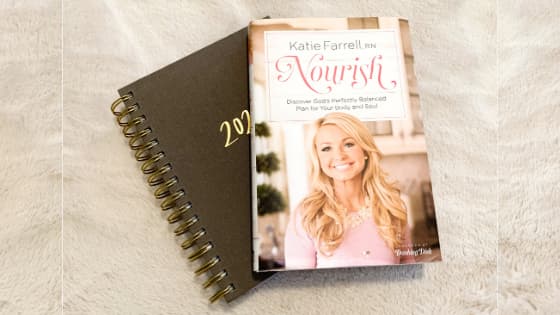
Katie Farrell has been able to turn her past struggles with eating disorders into an avenue to help others with their struggles. When I read Nourish, I was impressed by how she approached health. She not only addressed physical health but also included spiritual and emotional health for a complete approach. In fact, her philosophy begins with a spiritual component that emphasizes a personal relationship with our Creator. It begins with a godly mindset.
“A mind defended with God’s Word has the power to be renewed until it conforms to the image of Christ.”
The reality is the enemy uses food against us. Food can become an addiction, whether we eat too much or too little. And unlike other addictions, we can’t live without food. In C.S. Lewis’s Screwtape Letters, the topic of gluttony is addressed in a way I had never encountered before. I had always defined gluttony as eating too much, but Lewis points out that gluttony is making food an idol in any way. With this definition, being too picky, obsessively counting calories, even refusing food that someone has lovingly made could be considered gluttony.
“I have found that it is only when we actively engage in a partnership with God that the impossible suddenly becomes possible.”
Farrell’s book contains guidelines for diet and exercise along with copies of healthy recipes, but everything is approached from a spiritual perspective first. Each chapter includes a prayer and tips for nourishing the soul. The thought-provoking questions help us to analyze our motivation for eating and exercising so they stay in their proper place and don’t become idols that hinder our relationship with Christ. In fact, Farrell even teaches us how to eat as an act of worship!
If you have struggled with maintaining a healthy lifestyle, and you would like to make sure you are keeping God at the center of this area of your life, I encourage you to read this book. It has changed the way I look at healthy eating and will be my go-to manual again and again as I walk this journey.

by Kelli Garms | Mar 20, 2020 | Spiritual Growth, Women's Ministry
As the date for this blog post was approaching, I struggled to know what to write. Our world has changed so much in the last week, and even I, who am not an anxious person by nature, can feel the tension in the air. I keep reminding myself that we have the most powerful weapon at our disposal: Prayer.
“The prayer of a righteous person has great power as it is working” (James 5:16b)
I have been using the prayer journal from Val Marie Paper this year, so I’ve used it to make a plan of prayer during these uncertain times. If you’ve struggled to know how and what to pray, use this guide to get started. You don’t have to stick with it verbatim as the Holy Spirit will prompt you and bring things to mind throughout your prayer journey, but it is a starting point for your prayers.
The Challenge:
God is still on the throne! He knew this was coming and was not caught by surprise.
Our World & Nation:
- The lost would turn to God
- Wisdom for our president and world leaders
- Healing of the infected
- Special grace for caregivers (both professional & family members)
- The economic stability of the country
- Military men and women who are in active service
My Community:
- My pastor and church leaders—wisdom, grace, patience, peace
- Schools and homeschool co-ops
- Parents who are unexpectedly home with their kids
- My neighbors
- My online community
My Loves (I use this category for my immediate family):
- My husband leading our family toward trusting in God; with wisdom; with compassion
- My children seeing us depend on God and not making decisions out of fear
- We would draw closer as a family during this time
- We would draw closer to God individually during this time
My Family (outside of my home):
- Health
- Safety at home, abroad, and during travel
- Draw closer to God
- Make decisions out of faith and not fear
Sweet Friends:
Personal (This list would be specific to you and your struggles):
- Surrender to God wholly
- Live in faith, not fear
- Encouraging and supportive wife
- Loving and compassionate mom
Other:
- Foster children who are in precarious situations
- Those who are quarantined in abusive homes
- Missionaries who are overseas
- Missionaries who are separated from children and family
I would like to close this blog post with a prayer and would be honored if you would join me.
Lord, these are unsettled times, and we are afraid. But You have told us that fear comes from the enemy because You gave us a spirit of love, power, and a sound mind. Give us the wisdom to lean into You instead of leaning into the things we are hearing all around us. Direct us to Your Word where we find Truth instead of to the news stations or social media where we find confusion. Give us that peace that confounds the world because they can’t understand it. And, Lord, above all, be glorified in what is happening and draw the lost that their lives may be changed forever as they surrender to Your authority. In Jesus’ name, Amen.

by Kelli Garms | Mar 6, 2020 | Spiritual Growth, Women's Ministry
“I am doing a great work and I cannot come down.” Nehemiah 6:3
I am a multi-passionate person. In fact, I can get passionate about almost anything you throw at me. My students are often shocked about my passion for grammar, of all things. This can be a stumbling block for me because I see opportunities all around me. Most of those opportunities are good, godly, productive opportunities I can easily justify. I have to be careful what I agree to do, or I will sacrifice the best things on the altar of the good things.
Over the last year, God has been working on me to walk away from the opportunities the enemy has used to distract me from the most important things. I realized I had built my life around things that were good but should not have been a priority. As a result, I had built walls instead of healing or building relationships. I had surrendered my authority in order to keep the peace. I had seen my children as a hindrance to my work instead of my most important work (though I never would have said that out loud).
How do we tell the difference between what is good and what is best? There are many books written on this subject, so I will not attempt to answer this question comprehensively. But there are things we don’t need to pray about or agonize over because Scripture clearly tells us what to do.
- You are God’s child, and He expects you to act like it. Your relationship with your Heavenly Father should never be sacrificed for your job, your workout, your vacation, your family.
- Only you can be your husband’s wife. If you are married at this time, God has given you a very clear role that only you can fill. It should be your priority.
- Only you can be your children’s momma. If you have children, young or grown, it is a divine assignment for only you. Do not mistake this divine assignment for a distraction.
Everything else in your life needs to be weighed against these three positions.
In our day-to-day grind, it can be difficult to discern what is best and what is urgent, and we often sacrifice the important for the urgent. We would do well to take the time to list everything on our plate and bring those things to the Lord, asking for wisdom. I have found when I’m thinking about stepping back from a commitment, God gives me peace or makes me restless. Restlessness means I’m headed in the wrong direction.
I’ll leave you with this reminder from Andy Stanley’s book Visioneering:
Don’t spend your time; invest it.