Depending on the number of verses you find, this step can take a couple of minutes, or it can take a long time. But this is an incredibly important step because the best way to make sure you are interpreting a passage correctly is to allow Scripture to interpret Scripture.
Cross-references are those tiny verses written in the margin or the center column of your Bible. Sometimes they are at the bottom of the page, too. If your Bible doesn’t have cross-references, you can use an app to find them. Blue Letter Bible is a great free resource that contains cross-references, and we will use it in future steps of the process, too.
How I Do It
Your process doesn’t have to look like mine, so if you find a way that works better for you, do it. I write down the cross-references in my notebook (remember the one we talked about in the introduction to the series?). This way, I don’t have to keep my finger on the page in my study Bible.
Once I’ve copied them all down, I start looking them up. By this point, I’m pretty familiar with the passage I’m studying, so I look for verses that help clarify or give examples pertaining to the passage. When I find a verse I want to connect to the passage, I circle it in my notebook. As I come across verses that don’t really help or are specific to words I don’t need clarified, I cross them out. I will take this further in future steps.
This step can seem unproductive at times, but other times, when you cross-reference the passage, you come across incredible nuggets that shine a whole new light on things. Remember, you can’t go wrong when you allow Scripture to interpret Scripture.
If you have come this far, you are well on your way to becoming a Bible scholar. If this is as far as you want to go, that’s ok. This series is designed so you start at step 1 and only go as far as your current season allows.
Tasks
Follow these steps with our passage, Proverbs 3:5-8.
If you would rather download this entire Bible study process in the free workbook, you can enter your information below, and it will be delivered directly to your email.
In 2020, the governments of the Unites States, Canada, and around the world, took it upon themselves to somehow protect the global population from a virus by imposing lockdowns that prevented church congregations from meeting. Three things quickly became obvious: 1) The virus was not nearly as deadly as had been predicted; 2) the measures taken were more damaging than the virus itself; and 3) there was a double standard as mobs took to the streets in protest of so called police brutality, yet the church doors remained shuttered.
Many churches not only complied with the government overreach, but also criticized those pastors who did not acquiesce to the government “guidelines.” I specifically remember when two churches and their pastors made headlines as they stood in opposition to the authorities dictating their worship: Grace Community Church in Los Angeles pastored by John MacArthur and GraceLife Church in Edmonton pastored by James Coates.
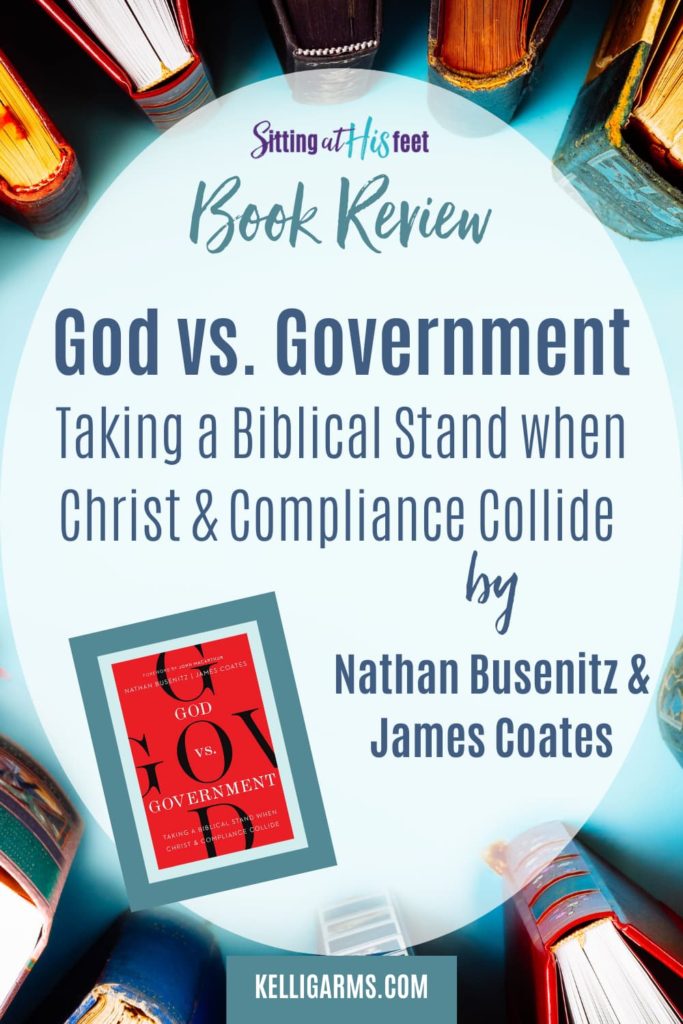
In their book, God vs. Government: Taking a Biblical Stand When Christ & Compliance Collide, Nathan Busenitz and James Coates not only tell their stories, including many details that were never reported by the media, but also explain the biblical basis behind the decisions they made and how those decisions impacted their ministries. Part 1 of the book details what happened in both churches. They describe everything from the decisions made by the elders to the law enforcement presence in their services to the law suits, trials, and consequences each church faced. In Canada, these consequences included a time when the church met in secret. Part 2 of the book includes sermons preached and biblical support for the actions taken by each church. The support provided is incredibly thorough and insightful.
While I highlighted so many lines in the book, one thing that has stuck with me is Coates’s reminder that the church is a flock and the pastor is its shepherd. When this analogy plays out, it is easy to see why a church that is not congregating is not fulfilling its purpose. He asks, “How can a shepherd feed an absent flock? How can he protect them? How can he tend to their wounds?” These questions are rhetorical because it is obvious the shepherd can’t do his duty if he is not with his flock.
I was also struck by how gracious Coates was toward those families who left GraceLife Church as a result of the decision not to comply with the lockdowns. He praised those families as being “instrumental in helping [the church] refine their thinking.” He goes on to say, “They led us to make sure we could defend the biblical veracity of the stance we had taken and helped us develop the courage and conviction needed for the battle yet to come.”
This book gives great insight and guidelines for knowing when it is appropriate to comply with the government and when it is imperative to resist it. Christians need to know where they stand before the next crisis hits, and hit it will. We can’t wait until we are in the thick of it again to figure out what we believe. Busenitz and Coates walk through Scripture and carefully lay out interpretations, boundaries, and guidance for the role of the government, the role of the family, and the role of the church.
** This book would be a great addition to a worldview curriculum and/or a government curriculum.
Now that you have read the passage multiple times and in different translations, it’s time to start asking some questions. A helpful tool for this step is the worksheet in my free Bible study workbook. If you haven’t already downloaded it, click on the link and get your copy ready.
One of the questions I am asked most often is which passages of Scripture to study. I discuss this in-depth in the worksheet companion video series. For now, we will continue studying Proverbs 3:5-8.
Author and Audience
Do a little research, and I mean a little, to find out who wrote the passage you are studying and to whom he wrote it. We are the audience now, but when the author penned the words, he meant it for a specific audience, and this information might be vital for correct interpretation of the passage.
We should always read the Bible the way the author intended it to be understood and not through our own filter or cultural lens. Knowing who wrote it, why he wrote it, and to whom he wrote it will help us get the interpretation right.
If you have a study Bible, you can usually find this information in the notes at the beginning of the book. If you don’t have a study Bible, you should be able to find out easily online, using sources like Biblegateway.com or the Blue Letter Bible app. Sometimes, the first few lines of the book will tell you, too.
Type of Literature
Another thing to keep in mind is the type of literature this passage represents. Is it history, prophecy, poetry, etc.?
For example, Proverbs is “wisdom literature.” This means it communicates principles that are generally true but not necessarily universally true. So the content of Proverbs should not be mistaken for promises. It is made up of general “if, then” statements, not specific promises from God to His people.
Don’t go down a rabbit hole with this one, just make a note of it. This information should be readily available in the same resources listed above.
Why Should You Paraphrase?
Now it is time to write the passage in your own words. This doesn’t have to be fancy or “churchy.” Just write down what the passage says in your normal, everyday words.
This step helps you think through and clarify the passage. Some passages have become so familiar to us or the language is so different from ours that we glaze over them without truly understanding them. Writing them in our own words forces us to process what the passage actually says.
Don’t be afraid to get this wrong. This is a beginning step, so it is ok to change your mind as you learn more about the verses throughout your study. If you struggle with this, I encourage you to watch the worksheet companion video series. I talk through some of the mental blocks this step creates.
Questions to Ask
The hardest part is done! (Sort of.) Now we just need to ask and answer some questions about the verses to deepen our understanding:
What do these verses teach me about God and His character?
Remember that the Bible is a book about God, so we read it to get to know Him, not ourselves. You will learn about yourself through your study, but it will be in light of Who God is. It takes the focus off of how the passage makes you feel and the filter you put on the verses.
This may seem a little out there, but I promise it will click if you stick with it. If you find that you can’t get past this question, watch the worksheet companion video series for some direction.
What should I learn from these verses?
Look for specific call-outs in the passage: a promise, a sin, a command, a principle, etc.
How should it change me?
This puts action behind your study. If we become simply consumers of the Word, but we don’t put it into action, the book of James says we are deceiving ourselves (1:22), and we won’t be blessed (1:25). This question is where the Holy Spirit convicts.
“So whoever knows the right thing to do and fails to do it, for him it is sin” (James 4:17).
And that is it for step 2! It may have been a lot for you to process, and that is ok. Stay on this step as long as you need to. You may decide this is as far as you want to go. This is a great way to work through an entire book of the Bible, and it is a good exercise to do along with your daily Bible reading.
Tasks
Using Proverbs 3:5-8 as the passage, work through these steps. You can use the free Bible study workbook or simply use a blank piece of paper or journal.
If you would rather download this entire Bible study process in the free workbook, you can enter your information below, and it will be delivered directly to your email.
Updated. This Bible study post was originally published on May 13, 2020.
In the last post, we walked through the introduction to this series by discussing the basic tools you need for Bible study. If you missed that post, you can read it here. Now let’s get started with the steps to study Scripture for ourselves.
Bible Study Step 1: Prayerfully Read the Passage
This step may seem pretty simple,but remember, the goal is to really know the passage at the end of this process, so prayerfully reading the passage needs to be intentional. Let’s break this down a bit.
Pray
Before you begin to study, you need to pray. You need to ask the Holy Spirit to partner with you. This means praying that He will keep the distractions at bay (the enemy will throw everything at you because he wants to make you ineffective), help you see things you haven’t seen before, and show you how the passage should change you.
This step requires you to put yourself in an environment conducive to learning. This will look different for each individual. For you, it might be music playing in the background before the kids get up, sitting in your special chair with a cup of coffee. It could look like reading on your phone in the middle of the night while you’re rocking a baby to sleep. Maybe it will be sitting on the park bench listening to the passage in one ear while you keep the other ear attuned to the kids playing on the playground. The point is, be open and receptive to what the Holy Spirit wants to teach you, and place yourself in a position and environment that is conducive to accomplishing that goal.
Read
When you read the passage, focus on the words used. If there is a word you don’t know, look it up or write it down for future research. Read the passage in several different translations. You can find apps with different translations and that also allow you to listen while you read along or do your chores.
Another great way to pore over the passage is to write it out with your own hand. Use that notebook we discussed in the last post. Choose one of the translations and copy the text. There is a strong connection created in your brain when you physically write something out.
Journal
And then take a minute to journal your thoughts. Did the reading bring up any questions? Did anything strike you as odd or impressive? Did you learn something new? This journaling doesn’t have to be long and involved, just jot down your first impressions as a place to begin.
If you have never done Bible study on your own or if this is a particularly busy season in your life, this may be as far as you want to go with the process. It is the most important step because the Word of God is living and active. Just spending intentional time in the Word will change your life.
Tasks:
Walk through this process using Proverbs 3:5-8. The first two verses might seem familiar to you, but you might be surprised how many nuggets we gloss over when the passage is well-known.
If you would rather download the process in a FREE workbook, you can enter your information below, and it will be delivered directly to your email.
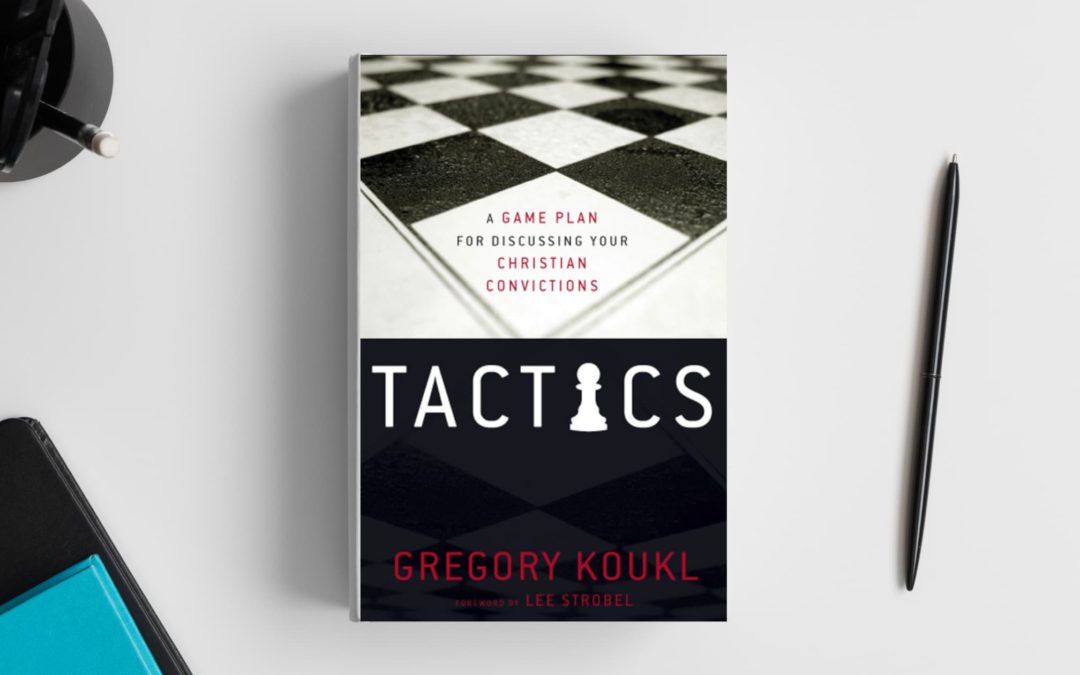
If you are intimidated to share the Gospel, contradict lies, or address controversy, Tactics: A Game Plan for Discussing Your Christian Convictions by Gregory Koukl is the book for you! Not only does it give the tools needed to have a respectful conversation, but also it gives ideas and examples to hone the skills it teaches.
I remember reading Tactics while I was struggling through another book that was full of logical fallacies (errors in reasoning). Koukl’s explanations and examples helped me identify those errors and gave me the tools to clarify my position. But the purpose of his book is to help us engage in real-time dialog.
As a general rule, probably because political correctness has so permeated our interactions, we think that arguing is wrong, sinful even. There is a difference between an argument and a fight. The truth is we should, especially as Christians, be able to argue our positions with knowledge, wisdom, and respect. Scripture tells us that we should always be ready with an answer to defend our faith (1 Peter 3:15).
In his book, Koukl provides the reader with tools to implement when having controversial conversations. This could be witnessing to an unbeliever, having a conversation about a culturally-relevant topic with someone on the other side of the issue, or debating the finer points of theology with a brother or sister in Christ. Koukl gives the reader specific examples and “tactics” to have a successful and respectful exchange.
One of my favorite principles discussed in the book is what I affectionately call “the pebble principle.” Our job as Christians is not to convince others they are wrong and we are right. Our job is to put a pebble in their shoe—you know, a thought they can’t get out of their heads that keeps rolling around until they have to do some research and find out the answer.
Koukl reminds us that “it’s not [our] job to defeat their claim. It’s their job to defend it.” As Christians, we often get caught up in trying to prove them wrong when they haven’t given any evidence that they are right. He reinforces this idea by demonstrating that questions are more effective than statements.
In fact, most of his book is dedicated to teaching the reader how to ask the right questions in different situations. The goal is not to “trap them” but to gain insight into their worldview and lead them to recognize its failure. This opens the door to share Christ and the consistent biblical worldview.
Another important lesson from the book is the difference between opinions and facts. Koukl reminds us there is a difference between giving an explanation and giving evidence. Our society often forgets that Christians are not the only ones who need to answer for their beliefs. Whoever makes the claim must be able to defend it, and his opinion is not proof. Critics of Christianity rarely are prepared to defend their own “faith,” but instead focus on attacking.
Not only does Koukl give us tactics to use in dialog like asking leading questions, identifying self-defeating arguments, and getting down to the facts of the claim, but also he teaches us what the other side will do to distract from their claim like attacking our character, deferring to an “expert,” or using disproven data. And he gives all of these tactics clever names to help us remember them!
He ends the book with practical steps and ideas to prepare ahead of time so when we have the opportunity to dialog, we are equipped. But he makes an important point when he says, “Know your Bible well enough to give an accurate answer. Tactics are not a substitute for knowledge. Cleverness without truth is manipulation.”
This book is an excellent addition to an apologetics, worldview, or logic curriculum.

 familiar with the passage I’m studying, so I look for verses that help clarify or give examples pertaining to the passage. When I find a verse I want to connect to the passage, I circle it in my notebook. As I come across verses that don’t really help or are specific to words I don’t need clarified, I cross them out. I will take this further in future steps.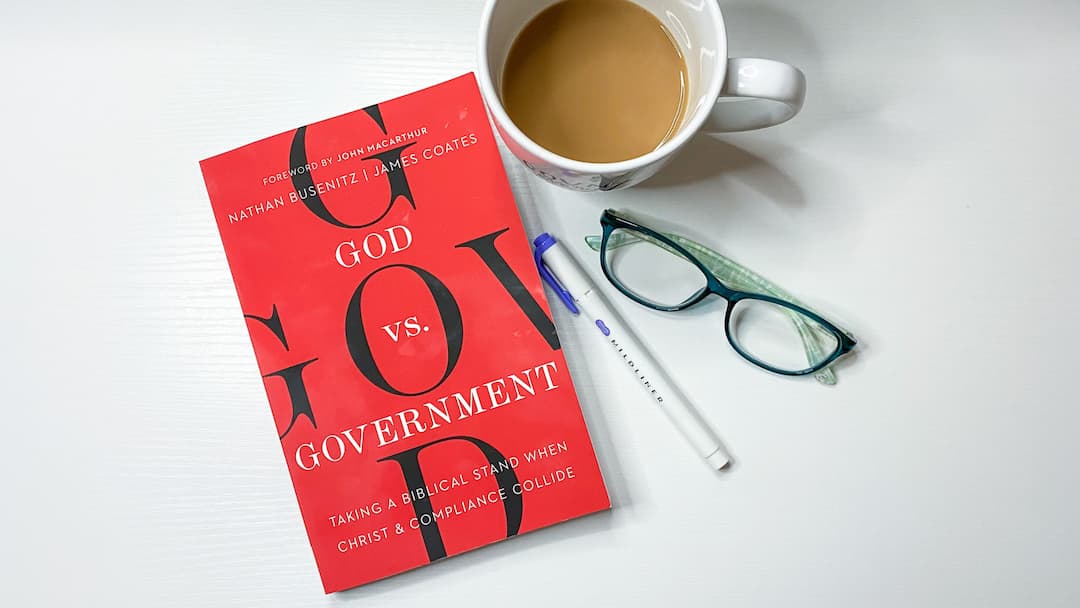

 For example, Proverbs is “wisdom literature.” This means it communicates principles that are generally true but not necessarily universally true. So the content of Proverbs should not be mistaken for promises. It is made up of general “if, then” statements, not specific promises from God to His people.