Updated. This Bible study post teaching you to pray the passage was originally published on June 5, 2020.
I know, I know, you thought we were done. But I couldn’t end a series about Bible study without bringing it back to prayer. And I couldn’t make this step 7 because it can and should be happening throughout the entire Bible study process.
One of my favorite ways to pray is to pray Scripture. The Bible is living and active, and as such, there are no more powerful words we can speak. Once you have spent time in the passage and have walked through all of the steps, your understanding of the Word will bring new light and perspective to it. When you pray the passage back to God, you know you are praying His will and His way since you are praying His words.
Simply take the content from the passage along with your understanding of it and reword it as a prayer on behalf of yourself, your loved ones, your nation, etc. Pray that the Holy Spirit will show you the best way to apply what you have learned and give you direction for how it should change your life.
We could do a whole different series on prayer, but for now, take a minute to write out a prayer that incorporates what you’ve learned in the passage you’re studying. Again, there is something that happens in our brains when we put pen to paper. God wired us that way.
Ok, now I’m done with the series. I pray you have come away from this process walking closer to the Lord.
Please reach out to me with any questions I may not have answered.
If you would rather download this entire Bible study process in the free workbook, you can enter your information below, and it will be delivered directly to your email.
In this step, it is time to transfer your notes to your Bible. If writing in your Bible gives you an anxiety attack, that’s ok. There are some work arounds for marking up the passage. Feel free to print out a copy of the verses on a piece of printer paper. Another option is to handwrite the verses in your notebook, and mark that up instead. Don’t stress if you don’t want to write in your Bible.
Tools
I figured the easiest way to show you the tools I use was to make a video. Click here to watch the video where I talk about pens and highlighters:
In the video, I talk about Sharpie pens, Bic pens, and Ink Joy pens. I also talk about the pros and cons of highlighters and gel highlighters.
Color Coding
This is a question I get often, and it’s very important to me that you know I don’t follow any color-coding system. If I tried to highlight certain themes, speakers, promises, etc. in their own colors, the process would become more of a project for me than Bible study.
My system for color is simple: no two sections that are back-to-back and have their own separate notes should be highlighted in the same color. That’s it. So as long as you have at least two colors, you can follow this process to mark up the passage.
Notes
I made a video where I have added my notes to Proverbs 3:5-8 in my Bible. Feel free to follow along as you add your notes to your Bible. You can watch the video here.
That’s it! You’ve made it to the end. I would love to know if you have learned anything new about the passage along the way.
If you would rather download this entire Bible study process in the free workbook, you can enter your information below, and it will be delivered directly to your email.
Often, we jump to apply a passage too quickly or we do it in a selfish way rather than a God-honoring way. When we seek to apply the passage, we should not ask the question, “what can I get out of this passage?” or “how does this passage help me?” Instead, we should ask “how should my understanding of this passage change my life, thoughts, and actions from now on?”
Read through your notes
Read through all of the notes you’ve taken so far. This includes any journaling you did at the beginning. It also includes the answers to the questions on the worksheet and the notes you took from your research. Don’t forget about the cross-references you chose for each verse.
As you read through the notes, ask yourself how the information should change you. It might be a behavior that needs to change. It could be a belief you’ve held that this passage disproves. It could be that the passage reinforces something you’ve known all along. Maybe God has a promise for the believer or a generally true statement.
Your answer may match what you wrote on the application section of the worksheet, or it might be a completely different Truth you find. This doesn’t have to be some grand revelation you have never heard before. In fact, in most cases, I find it is something I know to do but am not doing.
“So whoever knows the right thing to do and fails to do it, for him it is sin.”
James 4:17
This is the most important step. If we take all the other steps but fail to apply the passage, the exercise has been pointless. We will have accumulated knowledge but not made it useful.
We can take this a step further by writing down when or with whom we plan to practice this application. This isn’t always possible as it depends on the type of action the passage asks us to take, but sometimes it helps to keep us accountable to what the Word is teaching us to do.
Tasks
Read through the notes you’ve taken for Proverbs 3:5-8 and write down the application.
If you can, write down when or with whom you plan to take this action.
If you would rather download this entire Bible study process in the free workbook, you can enter your information below, and it will be delivered directly to your email.
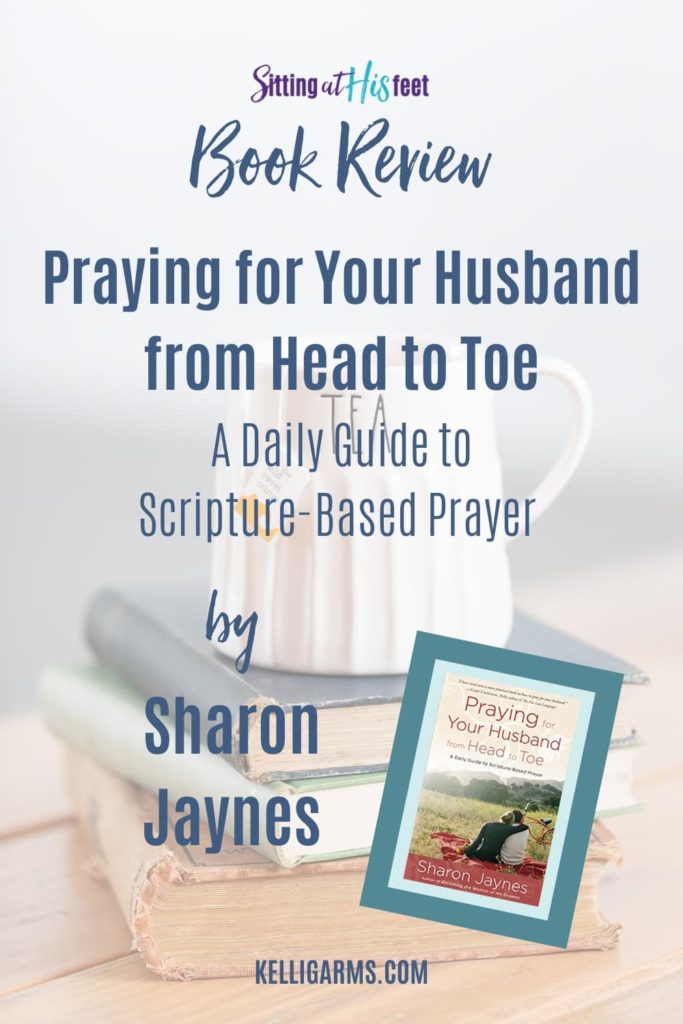
Updated. This book review of Praying for Your Husband from Head to Toe was originally published on January 10, 2020.
Although 2019 brought many memorable events in my life and our family, I will be honest and tell you I was not sad to see 2019 come to an end. It was a tough year. Mainly, it was a tough year for my marriage.
A major change in 2019 was moving our business from a small building we rented to a large building we purchased and remodeled. Mark and I had different expectations of the process and our roles during that time, and when those expectations weren’t met, it took a toll on our relationship. I vividly remember sitting on a couch in an Airbnb, pouring my heart and my tears out to a new friend who happens to be a marriage counselor.
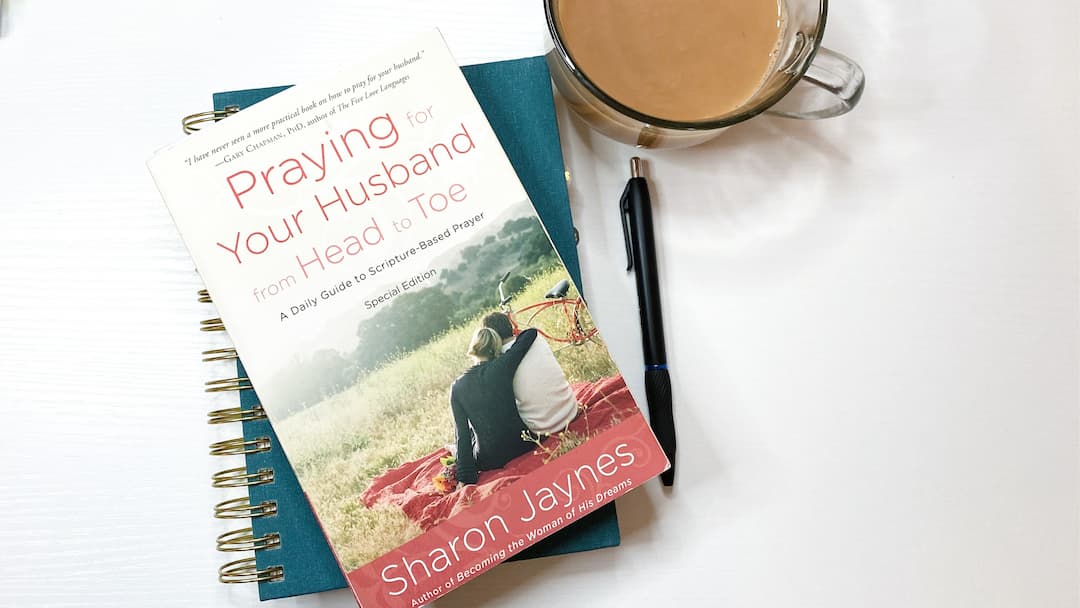
I went searching through my bookshelves for books I had on marriage, and I found Sharon Jaynes’s Praying for Your Husband from Head to Toe. I had bought it several months before based on a friend’s recommendation, but I hadn’t cracked it open yet. I had no idea what I had been missing!
This book teaches a pattern of prayer that has been a game-changer in my marriage. There have been many times I have cried through the prayers and many more times when I have prayed the prayers for myself and not just for Mark. I have even modified them to pray for my children.
It’s very easy to get stuck in a rut of prayer, especially when praying for those we pray for repeatedly. I can’t tell you how many times I’ve prayed, “Lord, be with Mark today.” This book has put words to my thoughts, paired Scripture with those words, and reminded me of things I’ve forgotten to pray for a long time. But it is not the book itself that is life-changing, it is the practice of prayer paired with Scripture.
I do not agree with nor endorse everything Jaynes includes in the book, but the prayer pattern she teaches, of praying for your husband literally from his mind to his feet and including Scripture for each part of his body along the way, has transformed my prayer life. These prayers can be modified to pray for anyone in your life. With small tweaks, they can be prayed for your children. You can use the pattern to pray for your parents, your siblings, your best friend, members of your Sunday school class, etc. You don’t have to be married to understand the benefits of having this tool in your arsenal.
Jaynes pairs Scripture with each prayer, which is so powerful because the Word of God is living and active. There is no better way to communicate with God than to pray His Word back to Him.
When I start this step, I want to make sure I keep all of the notes from each verse together in one place. I write the number corresponding to each verse down the left margin of my page, leaving enough room in between to take notes for each verse from several sources.
I add any cross-referenced verses I want to include next to the verse number (see Step 3: Cross-Reference the Passage). Even though you have already cross-referenced the verses, when you walk through this step, you may find more verses to add to your list.
Study Bible Notes
Once my note page is ready to go, I research the passage by looking at the notes in my study Bibles. If you don’t have a study Bible, don’t worry, there are plenty of resources available to you. I jot down anything I think adds to my understanding of the verses, including those things I understood myself in the previous work.
Feel free to take this step as deep as you want to take it. Many times, I will come across a concept referenced in the notes that leads me on a trail of discovery through other passages of Scripture. It can be a fun ride! These are things you should journal and come back to.
Apps and Online Resources
Once I have exhausted the notes in the study Bibles, I turn to some apps and online resources. I have accumulated several apps over this journey, but I started with the Blue Letter Bible app. This resource has a learning curve, so I will point out a place to start.
Once you have opened the Blue Letter Bible app and have found the passage, tap on a verse number and select “text commentaries.” On a side note, notice the study tools available in the top part of that menu. You can come back to those and learn how to use them.
Find a commentary that you can understand, and start reading what it says about your passage. Take notes as you read, keeping your notes organized by verse. When I research the passage, I always look for a commentary by David Guzik. He is easy to understand, and he includes notes from many of the other commentators in his commentary of the passages.
Repeat this step as many times as you want with as many commentaries as you’d like.
A Word of Caution
You need to do the steps of Bible study in order. Once you have spent personal time with the passage, asking the Holy Spirit to guide you in your study, and you have worked through the passage on your own and with cross-references, only then are you in a position to see what others say about the passage.
You will not agree with everything you read as you will find that many of the commentators contradict each other. Remember that the Word of God is inspired, but the notes of men are not. Yes, they have a lot of training and education, but on occasion, I have found a lone voice with whom I agreed about a passage.
Just because it is the popular belief does not mean it is the correct one.
And now, your page of notes should be a mess! Remember when I told you not to buy a fancy notebook? You’re welcome! Unfortunately, I learned this the hard way.
I urge you NOT to stop on this step. Although this series is set up for you to be able to start at step 1 and only go as far as you want to go, you have now reached a point where you should go to the next step: Apply the passage. You’ve done all of the hard work, and now it is time to implement.
Tasks
Using our passage of Proverbs 3:5-8, start your research. Don’t feel like you have to study every source at your disposal. Just pick a study Bible and a commentary with which to begin.
If you would rather download this entire Bible study process in the free workbook, you can enter your information below, and it will be delivered directly to your email.